
Introduction
Process safety in industries like oil & gas, petrochemicals, chemicals, and pharmaceuticals is not optional—it’s critical. One major incident can lead to catastrophic loss of life, environmental damage, regulatory action, and financial ruin. To prevent such outcomes, organizations must perform thorough Process Hazard Analysis (PHA) to systematically identify and evaluate potential risks.
PHA is a structured and systematic assessment of the hazards associated with industrial processes. The most widely used PHA techniques include:
- HAZOP (Hazard and Operability Study)
- HAZID (Hazard Identification)
- What-If Analysis, FMEA, LOPA, and more.
In this comprehensive guide, we’ll explore the methodology, use cases, industry standards, and practical execution strategies for PHA studies.
👉 Internal Link: List of Process Safety Studies
What is Process Hazard Analysis (PHA)?
PHA is a regulatory requirement and engineering best practice used to identify, analyze, and evaluate potential hazards associated with a process. It is often performed:
- During new design (FEED or detailed engineering)
- As part of Management of Change (MOC)
- Every 5 years as part of PSM revalidation
- After major incidents or near misses
The PHA process helps in:
- Understanding potential scenarios that can lead to harm
- Identifying safeguards and risk gaps
- Recommending additional protection layers or design changes
Key Objectives of PHA Studies
- Identify credible process hazards
- Determine cause-consequence scenarios
- Evaluate effectiveness of existing safeguards
- Recommend corrective actions or design improvements
- Support other studies like QRA, SIL, F&G Mapping
Regulatory Framework Supporting PHA
| Region | Standard |
|---|---|
| USA | OSHA 29 CFR 1910.119 (PSM Standard) |
| India | Factories Act, MSIHC Rules, PESO Guidelines |
| EU | Seveso III Directive |
| Global | CCPS Guidelines, IEC 61511, API RP 750 |
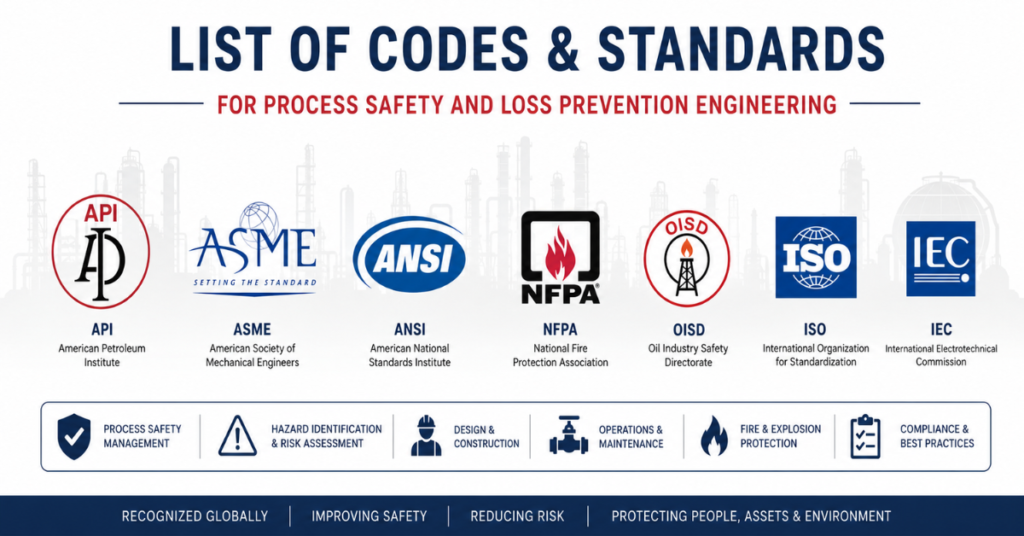
👉 Internal Link: Codes & Standards for Process Safety
Common PHA Techniques
| Technique | Description |
|---|---|
| HAZOP | Identifies deviations using guidewords; most rigorous |
| HAZID | High-level hazard identification; usually qualitative |
| What-If | Brainstorming “What if…” scenarios |
| FMEA | Failure Mode and Effects Analysis |
| LOPA | Layer of Protection Analysis |
| Checklists | Predefined list-based approach |
1. HAZOP – Hazard and Operability Study
What is HAZOP?
HAZOP is a systematic, team-based technique that identifies potential hazards and operability problems in processes by analyzing deviations from design intent using structured guidewords.
When is HAZOP used?
- During design stage
- Prior to plant commissioning
- For MOC reviews
- As part of 5-year PSM cycle
How is HAZOP Conducted?
| Element | Description |
|---|---|
| Nodes | Sections of the process (e.g., reactor, pump) |
| Parameters | Flow, pressure, temperature, level |
| Guidewords | No, More, Less, Reverse, Other than, As well as |
| Team | Chairperson, Process Engineer, Operations, Safety, Instrumentation, Maintenance |
Typical HAZOP Output
| Deviation | Cause | Consequence | Safeguard | Recommendation |
|---|---|---|---|---|
| Low Flow | Valve closed | Reactor damage | Flow alarm | Add low-flow interlock |
👉 Internal Link: HAZOP Study – A Detailed Guide
2. HAZID – Hazard Identification Study
What is HAZID?
HAZID is a high-level qualitative study used in early design stages to identify potential hazards before detailed design is available. It helps in:
- Defining safety philosophy
- Prioritizing detailed risk studies
- Early decision-making for layout and equipment placement
Common HAZID Categories:
- Fire and explosion
- Toxic releases
- Utility failures
- Natural hazards (lightning, flood)
- Security threats
- Ergonomics and human error
Tools and Techniques
- Brainstorming
- Checklists (e.g., ISO 17776)
- Bowtie diagrams
- Preliminary Hazard List (PHL)
Comparison of HAZOP vs HAZID
| Criteria | HAZOP | HAZID |
|---|---|---|
| Stage | Detailed design | Conceptual / FEED |
| Depth | Detailed | High-level |
| Team | Engineering-focused | Multidisciplinary |
| Output | Actionable deviations | Hazard inventory |
| Use Case | MOC, PSM, SIL | QRA, Layout decisions |
3. Other PHA Techniques
A. What-If Analysis
A brainstorming tool that explores “What if X happens?” and analyzes responses. Often used in early hazard screening.
B. FMEA (Failure Modes & Effects Analysis)
Evaluates failure modes for components and their impact on the system. Common in equipment-level risk analysis.
C. LOPA (Layer of Protection Analysis)
A semi-quantitative technique that evaluates whether existing safeguards are adequate. Supports SIL determination.
👉 Internal Link: SIL Study Guide
Team Composition for PHA
- Chairperson/Facilitator – Trained in PHA methodologies
- Process Engineer
- Operations Representative
- Instrument Engineer
- Maintenance Specialist
- HSE Coordinator
- Client Representative (for EPC projects)
Tools and Software for PHA
| Software | Features |
|---|---|
| PHA Pro | HAZOP/LOPA documentation |
| PHAWorks RA Edition | LOPA, HAZOP, What-if analysis |
| BowTieXP | Visual risk modeling (Bowtie) |
| ProSys | Integrated with engineering data |
| Intelex / Enablon | Enterprise risk management tools |
PHA Report – Essential Components
- Executive summary
- Scope and methodology
- Team and session details
- HAZOP/HAZID tables
- Risk ranking and matrix
- Recommendations and responsible persons
- Action tracking log
Case Study: HAZOP in Crude Distillation Unit (CDU)
Key Deviations Identified:
- High temperature in furnace → Runaway reaction
- Low reflux → Poor product separation
- Column flooding → Compressor surge
Recommendations:
- Add high-temperature trip
- Introduce additional level indication
- Validate PSV sizing based on maximum heat input
Outcome: Enhanced operability and risk mitigation measures implemented before commissioning.
Integration with Other Studies
| Study | Integration with PHA |
|---|---|
| QRA | PHA outcomes feed into frequency and severity data |
| FERA | Fire/explosion scenarios developed from PHA |
| EERA | Evacuation scenarios based on worst-case PHA outcomes |
| SIL | LOPA branch from PHA |
| COMAH/Seveso III | Safety reports use PHA outcomes as inputs |
👉 Internal Link: FERA Study – Fire and Explosion Risk Analysis
Benefits of Effective PHA Studies
- Early identification of design flaws
- Enhanced operability and maintainability
- Reduced likelihood of incidents
- Supports compliance and regulatory approval
- Saves cost through preventive actions
Challenges and Best Practices
| Challenge | Best Practice |
|---|---|
| Lack of experienced facilitator | Hire certified HAZOP Chairpersons |
| Incomplete P&IDs or drawings | Freeze documents before PHA |
| Weak participation | Pre-session training for all participants |
| Ignoring human factors | Include HSE and ergonomics in discussion |
| Action follow-up gaps | Assign responsibilities with deadlines |
FAQs
Q1: Is HAZOP mandatory?
Yes, it is a regulatory requirement under OSHA PSM and Indian MSIHC Rules for processes involving hazardous materials.
Q2: How long does a PHA study take?
Depends on complexity; for large units, 2–3 weeks. For smaller systems, 3–5 days.
Q3: What is the validity period of PHA?
Typically 5 years. However, it should be updated after major modifications or incidents.
Q4: Can PHA be done remotely?
Yes, with tools like MS Teams or Zoom and digital P&IDs, but effectiveness depends on preparation and team engagement.
Conclusion
PHA studies form the backbone of process safety. Techniques like HAZOP, HAZID, What-If, LOPA, and FMEA allow industries to proactively identify and address risks before they lead to disasters.
Whether you’re developing a greenfield refinery or modifying a brownfield process, integrating a well-structured PHA not only ensures compliance but drives engineering excellence and operational integrity.
By embedding PHA in your safety culture, you’re building a resilient, proactive, and sustainable industrial operation.

Dear Sir,
We are looking for a strategic partner for Offshore PHA studies. Are you interested in such a partnership?
Thanx & regards,
For, GREEN CIRCLE, INC.,
Pradeep Joshi
Group President & CEO
GREEN CIRCLE, INC.,
Integrated HSEQR Consulting Engineers, Scientists & Trainers
Certified for ISO 9001, 17025/NABL, 14001 & 45001
Cell ++91 9824272844 (WhatsApp) / ++ 9426721681 (India)
Email : pradeep.joshi@gccipl.net / info@greencircleinc.com
http://www.greencircleinc.com
also visit http://www.envergy.co.in
Think HSE 24 x 7