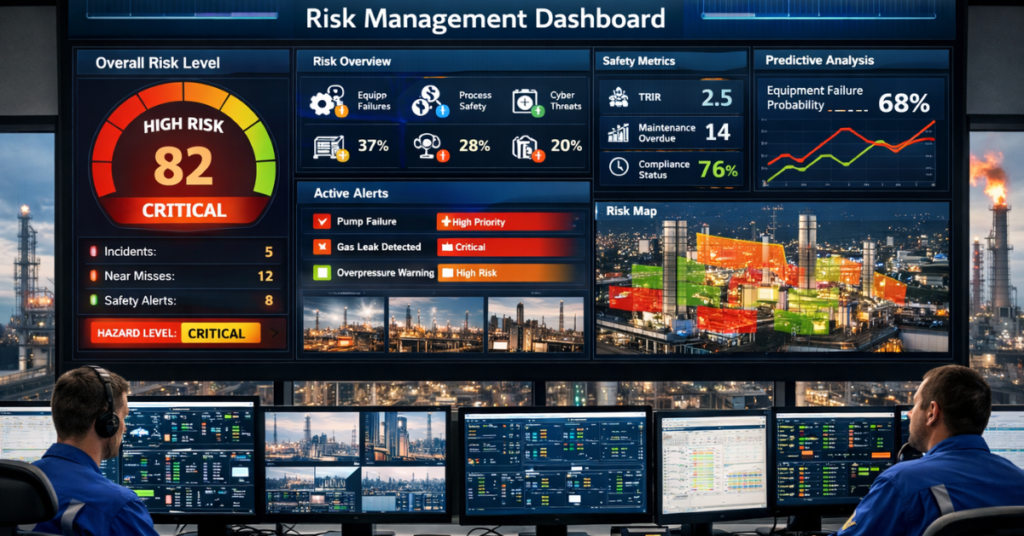
specialty chemical plants, risk is inherently dynamic and continuously evolving. These facilities operate under complex thermodynamic, chemical, and mechanical conditions where small deviations can escalate rapidly if not properly controlled. Unlike low-risk environments, process plants handle large inventories of flammable, explosive, toxic, and high-pressure substances. The interaction between process variables, equipment integrity, control systems, and human intervention creates a constantly shifting risk landscape.
Process conditions rarely remain constant. Feed composition may vary. Ambient temperature changes can affect vapor pressure and dispersion behavior. Production demands may push systems toward upper operating limits. Control loops may drift. Simultaneous operations (SIMOPS) may introduce temporary risk interactions. Start-up and shutdown phases inherently carry higher risk than steady-state operations. Even routine maintenance activities can alter plant risk profiles by impairing safety barriers.
Equipment degradation is another critical factor. Corrosion, erosion, fatigue cracking, seal deterioration, valve stiction, fouling, and instrumentation drift progressively change failure probabilities. A pressure vessel designed with a large safety margin may, over time, approach minimum allowable wall thickness. Rotating equipment may develop vibration issues that increase the likelihood of seal failure. Relief valves may experience set-point drift. Firewater pumps may suffer reduced performance due to mechanical wear. These degradation mechanisms do not align neatly with the assumptions made during design-phase risk studies.
Safety barriers, which are the backbone of process safety, can also become impaired. Safety Instrumented Functions (SIFs) may be bypassed for testing. Gas detectors may be temporarily isolated during maintenance. Firewater pumps may be out of service. Emergency shutdown valves may fail partial stroke testing. Passive fire protection coatings may deteriorate. When one or more barriers are unavailable, the overall risk picture changes significantly. Static studies often assume full barrier availability, but operational reality frequently deviates from this ideal condition.
Human performance introduces another dynamic variable. Operator workload fluctuates depending on alarm frequency, process upsets, and staffing levels. Fatigue during night shifts can influence response time. Communication breakdowns during shift handover may reduce situational awareness. Emergency drills may reveal gaps in response readiness. Human reliability is not fixed; it varies with context, stress level, and system complexity.
Environmental conditions further influence operational risk. Offshore platforms face changing weather, wave heights, and wind direction, which affect evacuation feasibility and dispersion modeling. LNG terminals may experience temperature variations influencing vapor cloud behavior. Lightning strikes, flooding, seismic activity, or sandstorms can stress both active and passive safety systems. These factors alter escalation potential and emergency response capability.
Traditional risk studies such as HAZID (Hazard Identification), HAZOP (Hazard and Operability Study), LOPA (Layer of Protection Analysis), SIL verification, and Quantitative Risk Assessment (QRA) provide a robust foundation during project development and periodic review. These methodologies systematically identify hazards, evaluate initiating events, quantify consequence severity, and determine required protection layers. They are indispensable tools in the process safety lifecycle and align with recognized frameworks such as those guided by the International Electrotechnical Commission for functional safety and the Occupational Safety and Health Administration for Process Safety Management principles.
However, these studies are fundamentally based on assumptions that represent a snapshot in time. They typically consider design conditions, standard operating parameters, and assumed barrier reliability. While periodic revalidation ensures continued relevance, the interval between reviews can span several years. During this time, operational deviations, temporary impairments, and cumulative degradation may significantly shift the actual risk profile away from documented assumptions.
For example, a QRA may calculate societal risk contours assuming full availability of firewater pumps and gas detection coverage. If one pump is under repair and several detectors are impaired, the real-time risk exposure may exceed the documented tolerability criteria. Static documentation does not automatically adjust to reflect these operational realities.
This gap between documented risk and actual operational risk is where Dynamic Risk Assessment (DRA) becomes a critical component of modern Technical Safety Engineering.
Dynamic Risk Assessment introduces a continuous layer of risk evaluation that reflects live plant conditions. Rather than relying solely on historical failure data and static probabilities, DRA integrates real-time operational inputs such as:
- Process pressures, temperatures, and flow rates
- Alarm states and deviation trends
- Equipment health indicators
- Barrier impairment status
- Maintenance backlog
- Environmental conditions
- Human intervention factors
By feeding these inputs into fault tree and event tree models, DRA recalculates initiating event frequencies and barrier effectiveness dynamically. If a Safety Instrumented Function is bypassed, its Probability of Failure on Demand (PFD) can be temporarily adjusted within the risk model. If corrosion monitoring indicates accelerated degradation, leak frequency assumptions can be modified. If multiple alarms indicate escalating deviation, escalation likelihood can be updated in near real-time.
Barrier Health Monitoring (BHM) is a central pillar of DRA. Instead of assuming constant reliability, DRA evaluates whether each preventive and mitigative barrier is available, degraded, or impaired. The system can generate a live barrier status matrix showing the cumulative impact of impairments on overall risk. This allows operations and technical safety teams to prioritize restoration activities based on actual risk impact rather than maintenance convenience.
DRA also enhances emergency preparedness. If gas detection indicates rising hydrocarbon concentration and wind direction shifts toward occupied buildings, DRA systems can dynamically update potential impact zones. This supports more informed decisions regarding evacuation, isolation, or controlled shutdown.
From a regulatory standpoint, DRA strengthens compliance with major accident hazard frameworks by demonstrating continuous safety assurance rather than periodic validation. It supports evidence-based justification of barrier availability, impairment management, and operational decision-making.
From a loss prevention perspective, DRA enables earlier detection of risk escalation pathways before they reach critical thresholds. It reduces reliance on reactive alarm management by providing contextualized risk insights. Instead of treating alarms as isolated events, DRA interprets them within a structured risk model framework.
Ultimately, Dynamic Risk Assessment transforms safety management from a periodic analytical exercise into a living, continuously updated risk intelligence system. It bridges the gap between design assumptions and operational reality. In complex, high-hazard environments where conditions evolve rapidly, DRA provides the situational awareness necessary to prevent major accidents, protect personnel, safeguard assets, and maintain environmental integrity.
This detailed technical guide explores DRA from the perspectives of safety engineering methodology, regulatory alignment, barrier performance management, and advanced loss prevention strategy, providing a comprehensive understanding of its role in modern process plant risk management.
1. What is Dynamic Risk Assessment (DRA)?
Dynamic Risk Assessment (DRA) is an advanced, data-driven risk evaluation methodology that continuously assesses and updates the level of operational risk in a process facility based on live plant conditions. Unlike conventional risk assessments that rely on predefined assumptions and static probability values, DRA integrates real-time operational data with structured risk models to reflect the actual, current risk profile of the plant at any given moment.
In high-hazard process industries, risk is not a fixed number—it is a variable function influenced by multiple interacting parameters. DRA recognizes that initiating event frequencies, barrier effectiveness, escalation potential, and consequence severity can all change dynamically depending on plant conditions.
At its core, Dynamic Risk Assessment transforms traditional risk models—such as fault trees, event trees, bow-tie diagrams, and consequence simulations—into living analytical systems that continuously recalibrate based on evolving inputs.
1.1 Fundamental Concept of DRA
In traditional Quantitative Risk Assessment (QRA), risk is calculated as:
Risk = Frequency × Consequence
In DRA, both frequency and consequence are no longer fixed values derived solely from historical databases. Instead, they are continuously updated using real-time plant information, including:
- Operational deviations
- Barrier impairment status
- Equipment health monitoring
- Environmental variables
- Human performance indicators
This enables DRA to produce a dynamic risk index that reflects the real operational exposure rather than theoretical or historical averages.
1.2 Core Inputs That Drive Dynamic Risk Assessment
Dynamic Risk Assessment continuously updates hazard likelihood and consequence modeling based on several critical variables:
• Current Operating Conditions
Process plants rarely operate under perfectly steady-state conditions. Operating parameters such as:
- Pressure
- Temperature
- Flow rate
- Liquid levels
- Chemical composition
- Operating mode (startup, shutdown, transient, steady state)
directly influence the probability of equipment failure and severity of potential consequences.
For example:
- Operating a reactor at elevated pressure increases stored energy and rupture consequences.
- Higher hydrocarbon throughput increases leak mass release rate.
- Off-spec feed composition may increase reaction instability.
DRA monitors these deviations in real time through integration with the Distributed Control System (DCS), adjusting initiating event probabilities accordingly.
• Barrier Availability and Impairment
Process safety relies on multiple preventive and mitigative barriers, including:
- Pressure Safety Valves (PSVs)
- Safety Instrumented Functions (SIFs)
- Emergency Shutdown (ESD) systems
- Firewater pumps
- Deluge systems
- Gas and flame detection
- Passive fire protection
Traditional risk studies assume a predefined Probability of Failure on Demand (PFD) for each barrier, typically based on industry data and proof test intervals.
However, in operational reality:
- SIF loops may be bypassed during maintenance.
- Gas detectors may be isolated.
- Firewater pumps may be under repair.
- ESD valves may fail partial stroke tests.
Dynamic Risk Assessment continuously monitors barrier health status through integration with Safety Instrumented Systems aligned with International Electrotechnical Commission functional safety lifecycle standards.
If a barrier becomes unavailable or degraded, DRA immediately updates the overall risk calculation by modifying the barrier reliability factor within the risk model.
• Equipment Degradation Status
Mechanical integrity is a time-dependent variable. Equipment degradation mechanisms include:
- Corrosion
- Erosion
- Fatigue cracking
- Hydrogen embrittlement
- Thermal cycling damage
- Fouling
- Seal deterioration
Corrosion monitoring systems, vibration analysis, thickness measurements, and predictive maintenance tools feed degradation indicators into the DRA model.
For example:
- Reduced wall thickness increases rupture likelihood.
- Rising vibration amplitude increases seal failure probability.
- Overdue inspection increases uncertainty factor.
Instead of relying solely on generic failure rates, DRA incorporates condition-based probability adjustments to reflect actual equipment health.
• Human Intervention and Operational Behavior
Human performance is a critical factor in major accident scenarios. DRA can incorporate human reliability elements such as:
- Operator workload
- Alarm flood frequency
- Shift duration
- Bypass management activity
- SIMOPS (simultaneous operations)
- Maintenance crew presence in hazardous zones
If alarm rates exceed acceptable thresholds, operator response reliability may decrease. DRA can adjust human error probability parameters dynamically within event tree models.
This aligns with modern Process Safety Management principles advocated by Occupational Safety and Health Administration.
• Environmental Conditions
Environmental factors significantly influence consequence modeling and emergency response capability:
- Wind speed and direction affect gas dispersion.
- Ambient temperature affects vaporization rates.
- Humidity influences toxic exposure impact.
- Offshore wave height impacts evacuation capability.
- Lightning risk increases ignition probability.
By integrating meteorological data, DRA refines dispersion modeling and escalation assessment in real time.
1.3 Difference Between DRA and Static Assessments
Static risk assessments performed during:
- FEED (Front-End Engineering Design)
- Detailed Engineering
- Periodic revalidation studies
provide structured hazard identification and baseline quantification. However, they assume:
- Design operating envelope
- Full barrier availability
- Nominal environmental conditions
- Standard human performance levels
These assumptions represent a design snapshot.
Dynamic Risk Assessment, in contrast, reflects the current operational snapshot—including deviations, impairments, and degradation.
For example:
A QRA may calculate acceptable societal risk assuming two firewater pumps available. If one pump is unavailable due to maintenance, the real-time risk profile shifts. DRA captures this shift instantly.
1.4 System Integration Architecture of DRA
To function effectively, DRA integrates with multiple plant systems:
• Distributed Control Systems (DCS)
DCS provides real-time operational data such as:
- Process variable trends
- Alarm states
- Set-point deviations
- Mode changes
This data forms the backbone of live risk recalculation.
• Safety Instrumented Systems (SIS)
SIS provides:
- SIF bypass status
- Trip history
- Diagnostic health
- Proof test records
SIS data ensures barrier effectiveness is dynamically reflected.
• Fire & Gas Systems
Fire and Gas detection systems provide:
- Gas concentration levels
- Flame detection status
- Detector impairment flags
- Voting logic state
DRA integrates this information to adjust ignition probability and escalation potential.
• Maintenance Management Systems
Integration with maintenance databases allows:
- Tracking of overdue inspections
- Status of critical equipment
- Planned shutdowns
- Temporary impairments
Maintenance backlog can increase uncertainty and risk weighting.
• Corrosion Monitoring Systems
Corrosion probes, ultrasonic thickness measurements, and inspection records provide:
- Wall thickness trends
- Corrosion rate projections
- Remaining life estimates
This enables condition-based failure probability modeling.
• Asset Integrity Platforms
Asset integrity systems consolidate inspection data, risk-based inspection (RBI) outputs, and mechanical integrity records. DRA uses this information to refine frequency assumptions.
1.5 Technical Safety Objective of DRA
From a technical safety engineering perspective, Dynamic Risk Assessment answers a critical operational question:
“What is the current risk level of this facility right now?”
But beyond that, it also answers:
- Which barrier impairments are contributing most to risk?
- Is risk within tolerable criteria?
- Are we approaching escalation thresholds?
- Should production be reduced?
- Should temporary operations be restricted?
- Is shutdown required?
DRA supports real-time decision-making by converting complex operational data into actionable risk intelligence.
1.6 DRA as a Continuous Safety Assurance Layer
Dynamic Risk Assessment acts as a bridge between:
- Design-phase safety engineering
- Operational integrity management
- Real-time decision support
It transforms risk management from a periodic compliance activity into a continuous safety assurance system.
Rather than relying on static documentation, DRA ensures that plant risk remains visible, measurable, and controllable at every moment of operation.
In modern high-hazard facilities, this capability is no longer optional—it is becoming a defining element of advanced Technical Safety Engineering and Major Accident Hazard management.
2. Why Static Risk Assessment Is Not Enough
Traditional risk assessment methodologies such as HAZOP (Hazard and Operability Study), LOPA (Layer of Protection Analysis), SIL verification, and Quantitative Risk Assessment (QRA) form the backbone of process safety engineering. They are systematic, structured, and essential during project development, design validation, and periodic revalidation. These studies help identify hazards, evaluate potential initiating events, quantify consequence severity, and determine the required layers of protection.
However, despite their importance, static risk assessments are inherently limited because they are based on assumptions that represent a fixed point in time.
In reality, process plants operate in a continuously changing environment where those assumptions may no longer remain valid.
2.1 Assumptions Embedded in Static Risk Studies
Traditional studies like HAZOP and QRA typically assume:
- Design conditions are valid
Operating parameters such as pressure, temperature, throughput, and composition remain within the intended design envelope. - Barriers are fully functional
Safety Instrumented Functions (SIFs), Pressure Safety Valves (PSVs), firewater systems, and gas detection systems are available and performing according to their assumed Probability of Failure on Demand (PFD). - Maintenance is up to date
Inspection intervals are adhered to, proof tests are completed as scheduled, and equipment degradation remains within acceptable margins. - Environmental factors remain within assumed limits
Wind speed, temperature, and external hazards remain within design basis assumptions used during consequence modeling.
These assumptions are necessary to calculate baseline risk values. They allow engineers to develop fault trees, event trees, and consequence models that estimate individual and societal risk levels.
But these assumptions rarely hold perfectly during actual plant operation.
2.2 The Gap Between Design Assumptions and Operational Reality
In operational environments, conditions evolve continuously.
• Safety valves may be under maintenance
Pressure Safety Valves (PSVs) are often removed periodically for calibration and testing. During that period:
- The protective layer is temporarily unavailable.
- Redundancy may be reduced.
- Escalation potential increases.
Static QRA models typically assume the PSV is operational with a defined PFD. They do not dynamically reduce barrier reliability when it is physically unavailable.
• Gas detectors may be impaired
Gas detection systems are critical mitigative barriers. However:
- Detectors may be isolated during maintenance.
- Calibration drift may reduce sensitivity.
- Communication faults may cause blind spots.
If a detector in a congested area is impaired, ignition probability may increase because early detection is compromised. Static studies do not automatically adjust risk contours when detection coverage changes.
• One ESD loop may be bypassed
During testing or troubleshooting, Safety Instrumented Functions may be bypassed temporarily. While permit systems manage such bypasses administratively, the actual risk exposure increases because:
- The protective function is disabled.
- The Probability of Failure on Demand becomes effectively 1 during bypass.
- Escalation potential increases.
Traditional SIL verification calculations, typically aligned with standards from International Electrotechnical Commission, assume functional availability based on proof test intervals—not temporary operational bypass conditions.
• Production may be operating above nameplate capacity
Operational pressure to increase throughput may push units closer to upper operating limits:
- Higher mass inventory increases release consequences.
- Elevated pressure increases stored energy.
- Higher flow rates increase leak severity.
- Increased vibration may accelerate mechanical degradation.
Static risk assessments often use design basis parameters. They do not dynamically account for real-time deviations beyond nominal limits.
• Corrosion may have reduced wall thickness
Mechanical integrity is not static. Over time:
- Wall thickness decreases due to corrosion.
- Fatigue cracks propagate.
- Gaskets degrade.
- Instrument impulse lines clog.
Risk-Based Inspection (RBI) programs estimate remaining life, but degradation can accelerate unexpectedly due to:
- Process upsets
- Chemical contamination
- Temperature excursions
Static initiating event frequencies derived from generic databases do not reflect real-time condition-based degradation trends.
• Multiple simultaneous deviations may occur
Perhaps the most significant limitation of static studies is their inability to capture dynamic combinations of concurrent impairments.
For example:
- A PSV is under maintenance.
- A SIF loop is bypassed.
- One firewater pump is unavailable.
- Wind direction shifts toward occupied buildings.
- Production rate is elevated.
Individually, each condition may be considered tolerable under administrative controls. However, combined, they may create an unacceptable escalation pathway.
Static assessments evaluate predefined scenarios. They do not continuously recompute risk when multiple impairments overlap.
2.3 Limitations of Periodic Revalidation
Regulatory frameworks such as Process Safety Management under Occupational Safety and Health Administration require periodic revalidation of hazard analyses, typically every five years.
While this ensures systematic review, it does not address:
- Daily operational variability
- Temporary impairments
- Short-term risk spikes
- Unexpected degradation trends
- Real-time human performance variability
A five-year review cycle cannot capture risk fluctuations that occur within hours or days.
2.4 Static Risk Is a Snapshot — Operations Are a Movie
Static assessments provide a snapshot of risk under assumed stable conditions.
But plant operation is more like a continuous movie:
- Startup sequences
- Shutdown conditions
- Transient disturbances
- Maintenance interventions
- Alarm floods
- Environmental changes
Risk fluctuates across these phases.
For example:
Startup conditions may involve:
- Increased manual interventions
- Temporary overrides
- Higher deviation frequency
- Reduced redundancy
Shutdown conditions may involve:
- Depressurization hazards
- Simultaneous operations
- Increased ignition sources
Static studies rarely differentiate risk profiles across these operational modes in real time.
2.5 Risk Tolerance and Escalation Awareness
Most facilities define risk acceptance criteria:
- Individual risk limits
- Societal risk contours
- ALARP (As Low As Reasonably Practicable) principles
However, without dynamic updating, operators cannot know whether:
- Current risk is trending toward intolerable regions.
- Temporary impairments push risk beyond tolerable limits.
- Risk has exceeded internal company thresholds.
Static documentation does not provide live risk indicators.
2.6 Why This Matters for Major Accident Prevention
Major accidents rarely occur due to a single failure. They occur when:
- Multiple protective layers are impaired.
- Degradation goes unnoticed.
- Escalation pathways align.
- Situational awareness is reduced.
Static assessments identify potential scenarios.
But they do not continuously monitor when real-world conditions begin to mirror those scenarios.
This creates a vulnerability gap between theoretical safety and operational reality.
2.7 How Dynamic Risk Assessment Closes the Gap
Dynamic Risk Assessment (DRA) addresses these limitations by:
- Continuously monitoring barrier availability.
- Updating initiating event frequencies based on equipment health.
- Adjusting consequence modeling based on real-time operating parameters.
- Accounting for temporary bypasses and impairments.
- Integrating environmental data.
- Reflecting simultaneous deviations within a unified risk model.
Instead of assuming full barrier availability, DRA calculates:
- Current effective barrier reliability.
- Real-time escalation probability.
- Updated individual and societal risk metrics.
As conditions change—whether due to maintenance, production changes, degradation, or environmental factors—DRA recalculates risk automatically.
2.8 From Static Compliance to Continuous Risk Intelligence
Static assessments remain essential. They provide:
- Baseline hazard identification.
- Structured documentation.
- Regulatory compliance evidence.
- Safety design validation.
But they are not sufficient alone in modern high-hazard facilities.
Dynamic Risk Assessment transforms risk management from:
Periodic analytical exercise → Continuous operational intelligence system.
In complex, high-risk process plants, where conditions evolve rapidly and multiple impairments may overlap, relying solely on static risk assessments leaves a blind spot.
DRA removes that blind spot by ensuring that risk is not just documented—but actively monitored, evaluated, and managed in real time.
3. Core Technical Components of Dynamic Risk Assessment
Dynamic Risk Assessment (DRA) is not a single software tool—it is an integrated technical architecture combining real-time data acquisition, reliability modeling, barrier performance tracking, and consequence simulation. Its effectiveness depends on how well these core components interact to reflect the true operational risk profile of a facility.
Below are the principal technical components that form the backbone of a robust DRA system.
3.1 Real-Time Data Acquisition
At the foundation of DRA lies continuous, high-quality data collection. Without accurate real-time data, dynamic risk modeling becomes unreliable. DRA systems rely on live data streams from multiple instrumentation and monitoring layers across the facility.
• Pressure Transmitters
Pressure measurement is critical in high-hazard systems:
- Overpressure increases rupture probability.
- High differential pressure may indicate blockage.
- Pressure spikes may signal control instability.
- Vacuum conditions may risk vessel collapse.
Real-time pressure trending allows DRA systems to identify abnormal stress conditions that increase initiating event frequency.
• Temperature Sensors
Temperature affects:
- Reaction stability
- Material integrity
- Vapor pressure and release rate
- Thermal expansion stress
- Auto-ignition probability
Elevated temperatures may accelerate corrosion rates or reduce material strength. DRA incorporates temperature data to dynamically adjust both frequency and consequence calculations.
• Flow Meters
Flow measurement is essential to determine:
- Leak mass release rate
- Inventory accumulation
- Process imbalance
- Pump performance degradation
Higher flow rates may increase potential release quantity and escalate consequence severity. DRA uses flow data to refine release modeling assumptions in real time.
• Gas Detectors (LEL and Toxic)
Gas detection systems provide early indication of:
- Hydrocarbon accumulation (LEL percentage)
- Toxic gas presence (H₂S, CO, NH₃, etc.)
- Leak severity progression
DRA systems use live gas concentration data to:
- Update ignition probability
- Recalculate escalation likelihood
- Trigger dynamic risk contour adjustments
If multiple detectors indicate rising LEL levels in a confined area, DRA can recognize clustering patterns and escalate risk levels accordingly.
• Flame Detectors
Flame detection confirms ignition events. In DRA systems:
- Delayed detection may increase escalation probability.
- Detector coverage impairment increases ignition consequence severity.
Live flame detection feedback helps refine real-time fire scenario modeling.
• Vibration Monitoring Systems
Vibration monitoring in rotating equipment (pumps, compressors, turbines) provides predictive failure indicators:
- Seal degradation
- Bearing failure
- Shaft misalignment
- Cavitation
Elevated vibration amplitude increases failure likelihood. DRA incorporates these condition-based indicators into initiating event frequency calculations.
• Corrosion Monitoring Probes
Corrosion monitoring systems measure:
- Wall thickness loss
- Corrosion rate trends
- Localized pitting
- Erosion velocity impact
If corrosion rates accelerate beyond expected values, DRA updates failure probability dynamically rather than relying on generic historical failure data.
• Firewater System Status
Mitigation reliability depends heavily on firewater system availability. DRA monitors:
- Pump operational status
- Jockey pump health
- Deluge valve position
- Water tank level
- Pressure in firewater ring main
If one firewater pump is unavailable, overall mitigation probability decreases. DRA immediately reflects this reduction in barrier effectiveness.
• ESD Valve Position Feedback
Emergency Shutdown (ESD) valves are critical isolation barriers. DRA monitors:
- Valve open/closed status
- Partial stroke test feedback
- Travel time deviations
- Failure to close indications
If an ESD valve fails testing or is under maintenance, the dynamic model adjusts isolation reliability.
Importance of High Data Integrity and Redundancy
Dynamic Risk Assessment is only as reliable as the data it consumes. Therefore:
- Sensor redundancy is essential.
- Communication networks must be secure and reliable.
- Data validation algorithms must filter noise and false signals.
- Cybersecurity controls must protect integrity.
Data corruption or latency can distort risk estimates. Therefore, high-integrity communication between OT (Operational Technology) and DRA platforms is critical.
3.2 Barrier Health Monitoring (BHM)
Barrier Health Monitoring is one of the most critical pillars of DRA. In process safety, risk is controlled through layers of protection. If these layers degrade, overall risk increases—even if process conditions remain stable.
BHM provides continuous evaluation of barrier effectiveness.
Types of Barriers Monitored
• Pressure Safety Valves (PSVs)
PSVs prevent overpressure. BHM tracks:
- Proof test compliance
- Maintenance removal
- Set-point drift
- Leakage indicators
If a PSV is overdue for testing or temporarily removed, its reliability assumption must be adjusted in the risk model.
• Safety Instrumented Functions (SIFs)
SIFs perform automated safety actions. BHM evaluates:
- Bypass status
- Diagnostic coverage
- Trip history
- Proof test interval compliance
- Hardware fault conditions
Standards from International Electrotechnical Commission IEC 61511 emphasize lifecycle functional safety management. DRA extends this concept into real-time operational awareness.
• Emergency Shutdown (ESD) Systems
ESD systems isolate hazardous inventories. Monitoring includes:
- Loop health
- Logic solver status
- Valve response verification
- Power supply redundancy
Loss of ESD functionality increases escalation probability.
• Firewater Pumps and Deluge Systems
Mitigation effectiveness depends on:
- Pump readiness
- Water pressure
- Valve availability
- Nozzle obstruction
- Flow testing results
Impaired firewater capability significantly affects fire consequence modeling.
• Passive Fire Protection (PFP)
Although passive, PFP degradation over time reduces structural fire resistance. Inspection records feed into DRA to adjust escalation modeling for prolonged fire exposure.
• Gas Detection Coverage
Detector impairment or calibration drift affects detection probability. BHM tracks:
- Fault signals
- Detector isolation
- Maintenance status
- Voting logic health
What Barrier Health Monitoring Evaluates
- Test interval compliance
- Temporary bypasses
- Failure probability recalculation
- Diagnostic system effectiveness
- Maintenance backlog impact
- Redundancy reduction
Barrier effectiveness is recalculated dynamically. If multiple barriers are impaired simultaneously, DRA detects cumulative risk increase.
3.3 Dynamic Frequency Updating
Traditional QRA uses fixed initiating event frequencies derived from historical databases. These values are conservative averages but do not reflect real-time plant conditions.
DRA introduces dynamic frequency recalculation.
Frequency is adjusted based on:
• Equipment Degradation
- Corrosion rate acceleration
- Wall thickness reduction
- Crack growth progression
- Fatigue damage accumulation
Example:
If corrosion monitoring shows wall thickness approaching minimum allowable limit, rupture probability increases exponentially—not linearly. DRA adjusts failure frequency accordingly.
• Operating Stress
Operating above design limits increases mechanical stress:
- Elevated pressure increases rupture likelihood.
- High temperature reduces material strength.
- Flow turbulence increases erosion.
DRA modifies initiating event frequency when operating stress exceeds nominal values.
• Human Factor Indicators
- Alarm flooding
- Operator workload
- Overtime shifts
- SIMOPS complexity
Human error probability increases under stress. DRA integrates human reliability adjustments.
• Maintenance Backlog
Overdue inspections increase uncertainty in equipment integrity. DRA applies risk weighting when preventive maintenance is delayed.
• Environmental Stressors
- Extreme weather
- Seismic activity
- Lightning exposure
- Flooding risk
Environmental stress modifies both frequency and escalation modeling.
3.4 Consequence Modeling Integration
Dynamic Risk Assessment does not only adjust frequency—it also updates consequence modeling.
DRA integrates advanced consequence simulation tools including:
• Dispersion Modeling
Gas dispersion depends on:
- Wind speed and direction
- Atmospheric stability class
- Release rate
- Temperature
Real-time meteorological data improves toxic and flammable cloud predictions.
• Fire Radiation Modeling
Jet fire or pool fire intensity depends on:
- Release pressure
- Inventory size
- Ignition timing
- Firewater availability
Live process conditions refine radiation contour calculations.
• Explosion Overpressure Modeling
Explosion severity depends on:
- Congestion level
- Gas concentration
- Ignition source probability
- Ventilation effectiveness
DRA updates overpressure zones based on real-time gas detection clustering.
• Toxic Impact Zones
For toxic releases (e.g., H₂S, chlorine, ammonia), DRA recalculates:
- Exposure concentration
- Downwind impact area
- Personnel vulnerability
Live meteorological input improves prediction accuracy.
Why Live Parameters Improve Accuracy
In static QRA:
- Release rates are assumed.
- Meteorological conditions are averaged.
- Barrier performance is fixed.
- Ignition probability is constant.
In DRA:
- Release mass flow is calculated using live pressure and flow.
- Wind data is real-time.
- Barrier effectiveness reflects actual availability.
- Ignition likelihood adjusts based on gas detection and electrical activity.
This significantly improves situational awareness during abnormal conditions.
Summary of Core Technical Components
Dynamic Risk Assessment combines:
- High-integrity real-time data acquisition
- Continuous barrier health evaluation
- Condition-based failure probability updates
- Live consequence simulation integration
Together, these components transform risk management from a static engineering document into a continuously updated operational safety intelligence system.
In high-hazard process facilities, this level of technical integration is essential to prevent escalation, maintain regulatory compliance, and protect life, environment, and critical assets.
4. Relationship Between DRA and Major Accident Hazard Management
Major Accident Hazard (MAH) management is the structured framework used to prevent catastrophic events such as explosions, large fires, toxic releases, and domino-effect incidents in high-hazard industries. These frameworks are built on the principle that organizations must systematically identify hazards, implement barriers, demonstrate risk tolerability, and continuously maintain control over accident scenarios.
Dynamic Risk Assessment (DRA) directly strengthens and modernizes Major Accident Hazard management by transforming it from a periodic compliance activity into a continuous safety assurance system.
4.1 Understanding Major Accident Hazard (MAH) Management
A Major Accident Hazard is typically defined as:
An occurrence such as a major emission, fire, or explosion resulting from uncontrolled developments in industrial operations that can lead to serious danger to human health, the environment, or property.
MAH management frameworks require organizations to:
- Identify credible major accident scenarios
- Implement preventive and mitigative barriers
- Demonstrate that risks are tolerable or ALARP
- Maintain barrier integrity throughout the asset lifecycle
- Provide documented evidence of control
Traditional MAH management relies heavily on:
- HAZID and HAZOP studies
- QRA and consequence modeling
- Safety Cases or Safety Reports
- Performance Standards for Safety-Critical Elements
- Periodic audits and inspections
While these mechanisms are essential, they are often document-based and periodic. DRA enhances them by adding real-time operational intelligence.
4.2 Alignment with Global Regulatory Frameworks
Dynamic Risk Assessment strengthens compliance with globally recognized MAH regulatory frameworks.
• Occupational Safety and Health Administration – Process Safety Management (PSM)
Under OSHA’s Process Safety Management (PSM) regulation (29 CFR 1910.119), facilities handling highly hazardous chemicals must implement:
- Process hazard analysis (PHA)
- Mechanical integrity programs
- Management of change (MOC)
- Operating procedures
- Emergency planning
- Incident investigation
- Compliance audits
PSM emphasizes mechanical integrity and ongoing risk control, not just initial hazard identification.
DRA supports PSM by:
- Continuously monitoring mechanical integrity indicators
- Tracking temporary impairments in real time
- Highlighting cumulative risk from bypassed safeguards
- Providing documented evidence of active risk monitoring
- Supporting MOC decisions with dynamic risk data
Instead of relying solely on periodic PHA revalidation, DRA demonstrates ongoing awareness of operational risk.
• Health and Safety Executive – COMAH Regulations
The UK COMAH (Control of Major Accident Hazards) Regulations require operators to:
- Prepare a Safety Report
- Demonstrate that all necessary measures are in place to prevent major accidents
- Show that risks are reduced to ALARP
- Maintain Safety-Critical Elements (SCEs)
A central expectation under COMAH is proof that:
- Safety-critical barriers are defined
- Performance standards are established
- Ongoing verification is conducted
DRA directly supports COMAH compliance by:
- Continuously tracking Safety-Critical Element availability
- Updating risk models when barriers are impaired
- Identifying when cumulative impairments push risk beyond tolerable levels
- Providing traceable documentation of barrier performance
This strengthens the operator’s ability to demonstrate “continuous control” rather than periodic compliance.
• International Organization for Standardization – ISO 31000 Risk Management
ISO 31000 defines risk management as:
Coordinated activities to direct and control an organization with regard to risk.
It emphasizes:
- Continuous monitoring and review
- Risk communication
- Integration into organizational processes
- Dynamic response to change
DRA aligns strongly with ISO 31000 principles by embedding risk awareness directly into operational decision-making. It transforms risk management from a reporting function into an active control mechanism.
4.3 Regulatory Expectations Are Evolving
Modern regulators increasingly expect evidence of:
• Demonstration of Barrier Effectiveness
It is no longer sufficient to show that barriers were installed during project execution. Regulators want assurance that:
- Barriers remain functional
- Proof tests are completed
- Temporary impairments are controlled
- Redundancy is maintained
- Performance standards are verified
DRA provides continuous barrier health dashboards and dynamic reliability updates.
• Real-Time Awareness of Impairment
Temporary impairments are common in operating facilities:
- SIF bypass during maintenance
- PSV removal for testing
- Firewater pump outage
- Detector isolation
- Electrical isolation
Regulators expect operators to understand the cumulative effect of these impairments.
DRA allows:
- Immediate visibility of barrier unavailability
- Recalculation of risk exposure
- Identification of high-risk combinations
- Decision support for restricting operations
• Continuous Safety Assurance
Major accident investigations consistently reveal that catastrophic events occur when:
- Multiple safeguards were impaired
- Risk awareness was reduced
- Cumulative effects were not recognized
- Operational pressure overrode safety caution
Regulatory bodies now expect operators to demonstrate ongoing situational awareness—not just documented procedures.
DRA provides:
- Live risk indices
- Real-time escalation tracking
- Barrier status matrices
- Early warning of risk threshold exceedance
This supports the concept of active major accident prevention.
4.4 DRA and Safety Case Philosophy
In jurisdictions requiring Safety Cases (e.g., offshore installations), operators must:
- Identify major accident hazards
- Describe control measures
- Demonstrate adequacy of safety management systems
- Show that risk remains within acceptable criteria
Static Safety Reports may become outdated if operational conditions change significantly.
DRA enhances Safety Case credibility by:
- Providing operational proof of barrier integrity
- Updating risk contours based on live data
- Identifying deviations from safety case assumptions
- Supporting continuous improvement of risk control measures
4.5 Evidence-Based Compliance Support
One of the most powerful contributions of DRA to MAH management is its ability to generate defensible evidence.
DRA systems can provide:
- Time-stamped records of barrier impairment
- Historical risk trend analysis
- Documentation of corrective actions
- Audit trails for regulatory review
- Performance benchmarking of safety-critical elements
This transforms regulatory discussions from theoretical justification to data-driven demonstration.
During audits or inspections, operators can show:
- Real-time risk dashboard outputs
- Barrier health history
- Escalation trend monitoring
- Decision logs tied to dynamic risk levels
This level of transparency strengthens regulatory confidence.
4.6 From Compliance to Proactive Risk Governance
Major Accident Hazard management is evolving from compliance-focused oversight toward proactive risk governance.
Traditional compliance asks:
- Were hazards identified?
- Were barriers installed?
- Are procedures documented?
Modern regulatory philosophy increasingly asks:
- Are you continuously aware of your current risk?
- Do you know when barriers are impaired?
- Can you detect risk escalation before loss of containment?
- Can you justify operational decisions under degraded conditions?
Dynamic Risk Assessment directly answers these questions.
4.7 Preventing the “Drift into Failure”
High-profile industrial disasters have demonstrated that major accidents often occur due to gradual drift:
- Maintenance delays
- Production pressure
- Repeated temporary bypasses
- Reduced vigilance
- Normalization of deviation
DRA reduces the risk of “drift into failure” by:
- Making cumulative impairments visible
- Quantifying risk increase over time
- Alerting management when tolerability thresholds are approached
- Providing early warning before escalation
This strengthens major accident prevention beyond procedural control.
4.8 Strategic Impact on Major Accident Hazard Management
Dynamic Risk Assessment enhances MAH management by:
- Bridging the gap between static safety cases and live operations
- Integrating mechanical integrity with risk modeling
- Making barrier performance measurable in real time
- Supporting defensible regulatory reporting
- Reducing probability of catastrophic escalation
In modern high-hazard process industries, regulators expect more than documentation—they expect demonstrable control.
DRA provides that control through continuous, evidence-based, and technically rigorous risk monitoring aligned with international major accident hazard frameworks.
It represents the natural evolution of Major Accident Hazard management from static compliance toward dynamic operational assurance.
5. DRA vs Traditional QRA: Technical Comparison
Quantitative Risk Assessment (QRA) has long been the cornerstone of Major Accident Hazard analysis in process industries. It provides structured, numerical evaluation of individual and societal risk through fault tree analysis, event tree modeling, consequence simulation, and frequency estimation. QRA is essential for demonstrating risk tolerability during design, regulatory approval, and periodic revalidation.
However, QRA is fundamentally a static, scenario-based methodology, while Dynamic Risk Assessment (DRA) is an operational, condition-based methodology. Understanding their differences clarifies why DRA complements—not replaces—traditional QRA.
Below is a detailed technical comparison.
Parameter 1: Frequency Data
| Aspect | Traditional QRA | Dynamic Risk Assessment |
|---|---|---|
| Frequency Source | Historical databases (OREDA, EI, generic failure rates) | Real-time condition-based adjustments |
| Update Frequency | Fixed during study period | Continuously updated |
| Sensitivity to Equipment Health | Limited | High |
Traditional QRA
In QRA, initiating event frequencies are typically derived from:
- Historical industry databases
- Generic component failure rates
- Published reliability statistics
- Expert judgment
These frequencies represent long-term statistical averages. They assume typical operating conditions and average equipment performance. Once calculated, these values remain fixed until the next revalidation study.
For example:
- A pipe rupture frequency may be assumed as 1E-4 per year.
- A valve failure rate may be derived from historical mean time between failures.
These values do not change dynamically based on current operating stress or degradation.
Dynamic Risk Assessment
DRA modifies initiating event frequency in response to:
- Measured wall thickness reduction
- Elevated operating pressure
- Increased vibration amplitude
- Accelerated corrosion rate
- Overdue inspection intervals
- Environmental stress conditions
For instance:
If corrosion monitoring indicates wall thickness approaching minimum allowable limits, the rupture probability is increased within the risk model.
Instead of assuming fixed reliability, DRA applies condition-based probability adjustment, significantly improving realism.
Parameter 2: Barrier Status
| Aspect | Traditional QRA | Dynamic Risk Assessment |
|---|---|---|
| Barrier Availability | Assumed functional | Continuously monitored |
| Temporary Impairments | Rarely modeled | Automatically reflected |
| Redundancy Reduction | Not dynamic | Real-time impact assessment |
Traditional QRA
QRA assumes barriers such as:
- Safety Instrumented Functions (SIFs)
- Pressure Safety Valves (PSVs)
- Firewater systems
- Gas detection systems
are available according to their design Probability of Failure on Demand (PFD). While proof test intervals are considered, temporary operational impairments are not dynamically included.
For example:
If a SIF is bypassed during maintenance, QRA does not automatically increase risk unless a manual reassessment is performed.
Dynamic Risk Assessment
DRA integrates with:
- Safety Instrumented Systems
- Maintenance databases
- Fire & Gas systems
When a barrier is:
- Bypassed
- Removed for testing
- Faulted
- Degraded
the risk model updates instantly.
If multiple barriers are impaired simultaneously, DRA detects cumulative risk escalation.
This aligns with functional safety lifecycle principles defined by International Electrotechnical Commission IEC 61511, extending them into operational awareness.
Parameter 3: Risk Reporting
| Aspect | Traditional QRA | Dynamic Risk Assessment |
|---|---|---|
| Reporting Frequency | Annual / periodic | Continuous |
| Format | Static report | Live dashboard |
| Trend Analysis | Limited | Real-time trending |
Traditional QRA
Risk results are typically presented as:
- Individual risk contours
- Societal FN curves
- Fatality potential metrics
- ALARP demonstration
These outputs are documented in a report and remain valid until revalidated.
Operators do not see daily changes in risk levels.
Dynamic Risk Assessment
DRA provides:
- Live risk indices
- Barrier health matrices
- Escalation alerts
- Trend graphs
- Risk tolerance threshold monitoring
Operators and management can view current risk status on dashboards similar to process variable displays.
If risk approaches predefined tolerability criteria, early warning alerts are triggered.
This transforms risk from a report-based output into an operational management tool.
Parameter 4: Degradation Modeling
| Aspect | Traditional QRA | Dynamic Risk Assessment |
|---|---|---|
| Degradation Treatment | Assumed average rates | Condition-based updates |
| Inspection Impact | Indirect | Direct model input |
| Remaining Life Consideration | Conservative assumption | Dynamic projection |
Traditional QRA
Degradation effects are incorporated indirectly through generic failure rates or conservative assumptions. Risk-Based Inspection (RBI) outputs may inform studies, but real-time degradation trends are not dynamically integrated.
For example:
If corrosion accelerates unexpectedly due to process upset, QRA assumptions remain unchanged until a new study is conducted.
Dynamic Risk Assessment
DRA integrates:
- Corrosion monitoring probes
- Ultrasonic thickness measurements
- Vibration trend analysis
- Predictive maintenance outputs
As degradation accelerates, failure frequency increases accordingly.
If inspection confirms acceptable integrity, risk may decrease relative to worst-case assumptions.
This allows DRA to provide more realistic, time-sensitive risk estimates.
Parameter 5: Emergency Decision Support
| Aspect | Traditional QRA | Dynamic Risk Assessment |
|---|---|---|
| Real-Time Support | Minimal | Immediate |
| Escalation Monitoring | Predefined scenarios | Live recalculation |
| Shutdown Decision Aid | Indirect | Direct recommendation support |
Traditional QRA
QRA identifies credible worst-case scenarios and consequence severity, but it does not function as a live decision-support tool.
During an abnormal situation:
- Operators rely on alarm systems.
- Emergency procedures guide response.
- QRA documentation provides background understanding.
It does not dynamically calculate real-time escalation probability.
Dynamic Risk Assessment
DRA continuously evaluates:
- Current release magnitude
- Ignition probability
- Barrier availability
- Environmental conditions
- Occupancy levels
During an abnormal event, DRA can:
- Update dispersion zones
- Estimate escalation likelihood
- Indicate whether risk exceeds tolerance criteria
- Support decision on production reduction or shutdown
This significantly improves situational awareness during evolving incidents.
5.1 Conceptual Difference: Design Tool vs Operational Tool
Traditional QRA is primarily:
- A design-phase validation tool
- A regulatory demonstration tool
- A strategic planning tool
Dynamic Risk Assessment is primarily:
- An operational risk management tool
- A real-time decision-support system
- A barrier assurance platform
QRA answers:
“Is this facility designed to meet acceptable risk criteria?”
DRA answers:
“Is this facility currently operating within acceptable risk criteria?”
5.2 Complementary Roles
It is critical to emphasize:
DRA does not replace QRA—it enhances it.
QRA provides:
- Structured hazard identification
- Baseline risk quantification
- Regulatory compliance demonstration
- Safety case foundation
DRA builds upon that foundation by:
- Using QRA logic structures dynamically
- Updating parameters based on live data
- Monitoring barrier integrity continuously
- Detecting cumulative impairment effects
Without QRA, DRA would lack structured risk logic.
Without DRA, QRA remains static and disconnected from daily operational variability.
Together, they create a comprehensive risk management ecosystem that integrates:
- Design assurance
- Mechanical integrity
- Barrier performance monitoring
- Real-time escalation awareness
5.3 Strategic Implication for Process Safety
Modern high-hazard facilities require both:
- Robust static risk modeling
- Continuous operational risk intelligence
QRA defines the acceptable risk envelope.
DRA ensures operations remain inside that envelope.
By integrating both approaches, organizations strengthen major accident prevention, improve regulatory defensibility, and enhance real-time safety governance in complex industrial environments.
6. Practical Example: Hydrocarbon Processing Unit
To understand the operational value of Dynamic Risk Assessment (DRA), consider a realistic scenario in a hydrocarbon processing unit—such as a reactor section in a refinery or petrochemical plant handling flammable feedstock under high pressure and temperature.
This example illustrates how DRA converts fragmented alarm signals into a structured, risk-informed decision framework.
Scenario Description
The unit is operating under steady-state production when the following conditions develop:
- Reactor temperature deviation detected (above normal operating range)
- Pressure trending upward toward high alarm limit
- Gas detector indicates 15% Lower Explosive Limit (LEL) in the reactor area
- One firewater pump is under maintenance
- One Safety Instrumented Function (SIF) loop is bypassed for calibration
Individually, each of these conditions may be manageable. However, collectively, they represent a complex, evolving risk scenario.
6.1 Understanding Each Deviation in Isolation
Before examining DRA’s integrated response, let’s evaluate each element technically.
1. Reactor Temperature Deviation
Elevated temperature in a hydrocarbon reactor may indicate:
- Reaction runaway potential
- Catalyst fouling
- Heat exchanger malfunction
- Control loop instability
Higher temperature increases:
- Vapor pressure
- Material stress
- Potential leak mass release rate
- Auto-ignition probability
2. Pressure Trending Upward
Increasing pressure may result from:
- Blocked outlet
- Control valve malfunction
- Exothermic reaction acceleration
- Relief path impairment
Higher pressure increases:
- Stored energy
- Rupture probability
- Leak release velocity
- Explosion overpressure potential
Temperature and pressure deviations combined significantly increase mechanical stress on containment systems.
3. Gas Detector at 15% LEL
A reading of 15% LEL indicates the presence of flammable vapor. While below ignition threshold, it signals:
- Active or developing leak
- Accumulating vapor cloud
- Increasing ignition potential
If concentration continues rising toward 100% LEL, explosion risk escalates rapidly.
4. Firewater Pump Under Maintenance
Firewater pumps are critical mitigative barriers. With one pump unavailable:
- Redundancy is reduced
- Fire suppression reliability decreases
- Escalation probability increases
- Cooling capacity for exposed equipment may be compromised
Mitigation effectiveness drops significantly when redundancy is lost.
5. SIF Loop Bypassed for Calibration
A Safety Instrumented Function (SIF) may normally:
- Trip feed flow
- Shut down reactor
- Isolate inventory
When bypassed:
- Automatic protection is unavailable
- Manual intervention becomes critical
- Probability of failure on demand becomes effectively 1
This is a major reduction in preventive barrier reliability.
6.2 How a Static System Would Interpret This Scenario
In a conventional static safety environment:
- Temperature alarm triggers operator response.
- Pressure alarm triggers high-pressure procedure.
- Gas detection triggers local alert.
- Maintenance records note pump unavailability.
- Permit system logs SIF bypass.
Each event is treated independently.
The operator sees multiple alarms but does not receive:
- A combined risk index
- Cumulative barrier degradation impact
- Escalation probability assessment
- Societal risk projection
There is no automated mechanism to quantify how these simultaneous conditions interact.
6.3 How Dynamic Risk Assessment Interprets the Same Scenario
Dynamic Risk Assessment integrates all inputs simultaneously within a structured fault tree and event tree logic model.
Here is how DRA processes the situation:
Step 1: Barrier Reliability Reduced
The DRA system detects:
- SIF bypass → preventive barrier removed
- Firewater pump offline → mitigation reliability reduced
The system recalculates:
- Effective Probability of Failure on Demand (PFD)
- Mitigation success probability
- Redundancy loss impact
Cumulative barrier effectiveness decreases.
Step 2: Initiating Event Frequency Updated
Elevated temperature and pressure increase:
- Probability of containment failure
- Stress-induced rupture likelihood
- Leak frequency
Instead of using static failure rates, DRA dynamically increases initiating event probability.
Step 3: Probability of Ignition Recalculated
With gas concentration at 15% LEL:
- Flammable cloud formation is confirmed
- Ignition likelihood increases
- Electrical equipment and hot surfaces become critical factors
DRA adjusts ignition probability based on:
- Gas concentration trend
- Area classification
- Presence of ignition sources
Step 4: Escalation Likelihood Updated
Because:
- Mitigation capacity is reduced
- Preventive trip is bypassed
- Gas cloud exists
- Process stress is increasing
The escalation probability increases significantly.
DRA recalculates:
- Fire scenario likelihood
- Explosion probability
- Potential domino impact on adjacent equipment
Step 5: Risk Contour Expands
Using live process parameters and meteorological data, DRA:
- Updates dispersion modeling
- Recalculates radiation zones
- Adjusts explosion overpressure contours
- Reassesses toxic exposure if applicable
The risk contour surrounding the unit expands based on:
- Increased release severity
- Reduced mitigation reliability
- Elevated ignition potential
This may temporarily move societal risk toward intolerable regions.
Step 6: Operator Alerted to Elevated Societal Risk
Rather than multiple independent alarms, the operator receives:
- A dynamic risk index
- A barrier impairment summary
- An escalation warning
- Risk threshold exceedance alert
The dashboard may indicate:
“Current unit risk exceeds normal operating threshold by 32% due to cumulative barrier impairment and elevated process stress.”
This transforms alarm overload into actionable risk intelligence.
6.4 Decision-Making Improvement Before Escalation
Because DRA integrates all variables simultaneously, it supports earlier and more informed decision-making, such as:
- Reducing feed rate to lower pressure
- Initiating controlled shutdown
- Restricting hot work nearby
- Accelerating firewater pump restoration
- Cancelling non-essential maintenance
- Increasing field monitoring
- Deploying standby firefighting resources
These actions occur before ignition or catastrophic escalation.
6.5 Why This Matters in Major Accident Prevention
Major accidents rarely result from a single deviation. They occur when:
- Process stress increases
- Preventive barriers are impaired
- Mitigative systems are unavailable
- Flammable or toxic inventory is present
- Situational awareness is reduced
DRA identifies when these factors align.
Instead of relying on human interpretation of separate alarms, DRA provides:
- Integrated scenario analysis
- Real-time risk quantification
- Escalation pathway identification
- Evidence-based operational guidance
6.6 Key Technical Insights from This Example
This practical example demonstrates:
- Static systems manage alarms.
- DRA manages risk.
It converts:
- Independent signals → Combined scenario modeling
- Administrative bypass tracking → Quantified barrier degradation
- Gas detection alert → Updated ignition probability
- Pressure deviation → Adjusted rupture likelihood
- Maintenance status → Reduced mitigation reliability
The result is a unified operational risk picture.
6.7 Final Technical Takeaway
In complex hydrocarbon processing environments, risk evolves rapidly. Static methodologies cannot capture the cumulative interaction of:
- Process deviation
- Barrier impairment
- Equipment degradation
- Environmental influence
Dynamic Risk Assessment provides continuous, integrated evaluation that improves decision-making before escalation occurs.
By detecting when multiple safeguards are weakened and process stress is rising, DRA acts as an early-warning system for major accident prevention—bridging the gap between alarm management and real-time safety intelligence.
7. Technical Architecture of a Dynamic Risk Assessment (DRA) System
A Dynamic Risk Assessment system is a multi-layered technical architecture that connects live plant data with structured risk logic and decision-support visualization. Unlike traditional risk tools that operate as standalone studies, a DRA system functions as an operational safety intelligence platform, embedded within the plant’s digital ecosystem.
Its architecture is typically divided into four tightly coupled layers:
- Data Layer
- Risk Engine
- Visualization Layer
- Integration Layer
Each layer plays a distinct role in transforming raw operational data into actionable, real-time risk insight.
7.1 Data Layer – Foundation of Dynamic Risk Intelligence
The data layer forms the backbone of DRA. It is responsible for collecting, validating, and streaming real-time and near-real-time data from across the facility.
Without a robust data layer, dynamic risk assessment is not possible.
7.1.1 Field Instrumentation
Field instrumentation provides direct visibility into the current process state. Typical inputs include:
- Pressure transmitters
- Temperature sensors
- Flow meters
- Level transmitters
- Gas detectors (flammable and toxic)
- Flame detectors
- Valve position indicators
- Motor and pump status feedback
These instruments capture deviations from normal operating conditions that directly influence initiating event probability and consequence severity.
For example:
- Rising pressure and temperature increase rupture likelihood.
- Elevated flow rates increase potential leak mass.
- Gas detection confirms loss of containment progression.
High data availability, redundancy, and validation logic are essential to avoid false risk escalation due to spurious signals.
7.1.2 Condition Monitoring Systems
Condition monitoring systems provide predictive insight into equipment health, enabling DRA to move beyond generic failure rates.
Typical condition monitoring inputs include:
- Vibration analysis for rotating equipment
- Bearing temperature monitoring
- Motor current signature analysis
- Acoustic emission monitoring
- Corrosion monitoring probes
- Ultrasonic thickness measurements
These systems detect degradation trends long before functional failure occurs.
For example:
- Increasing vibration amplitude raises seal failure probability.
- Accelerated corrosion rate increases pipe rupture likelihood.
- Abnormal motor current indicates impending pump failure.
DRA uses these degradation indicators to dynamically adjust initiating event frequencies rather than relying on historical averages.
7.1.3 Maintenance Databases
Maintenance management systems provide critical context regarding barrier availability and equipment integrity, including:
- Planned and unplanned maintenance activities
- Temporary removal of safety devices
- Bypass permits for SIFs and ESDs
- Overdue inspections
- Maintenance backlog
- Equipment out-of-service status
This data allows DRA to understand what protection layers are currently impaired and for how long.
For example:
- A PSV removed for testing temporarily eliminates an overpressure barrier.
- Overdue inspection increases uncertainty in mechanical integrity.
- Deferred maintenance increases cumulative risk weighting.
7.2 Risk Engine – The Analytical Core of DRA
The risk engine is the intelligence core of a DRA system. It converts raw data into quantified risk using structured probabilistic models.
Unlike static risk tools, the DRA risk engine continuously recalculates risk as inputs change.
7.2.1 Fault Tree Logic
Fault tree analysis models how combinations of failures lead to an initiating event, such as loss of containment.
In DRA:
- Basic event probabilities are not fixed.
- Failure probabilities are dynamically updated based on:
- Equipment condition
- Operating stress
- Maintenance status
- Environmental factors
For example:
- Pipe rupture probability increases as wall thickness decreases.
- Valve failure probability increases with vibration and overdue maintenance.
This transforms fault trees from static logic diagrams into live probability models.
7.2.2 Event Tree Logic
Event trees model what happens after an initiating event occurs, tracking the success or failure of protection layers and escalation pathways.
In DRA, event trees dynamically reflect:
- Actual barrier availability
- Temporary bypass conditions
- Reduced mitigation capacity
- Redundancy loss
For example:
- If a firewater pump is unavailable, the probability of successful fire mitigation decreases.
- If a SIF is bypassed, automatic shutdown probability becomes zero for that period.
Event tree outcomes are continuously recalculated, producing updated escalation likelihoods.
7.2.3 Bayesian Updating
Bayesian techniques allow the risk engine to update probabilities based on new evidence.
Instead of assuming fixed likelihoods, Bayesian updating enables:
- Adjustment of failure probabilities when new condition data arrives
- Incorporation of inspection results
- Reduction of uncertainty after successful testing
- Increase of uncertainty when inspections are overdue
For example:
- A successful pressure test may reduce rupture probability.
- A detected anomaly may increase likelihood of failure.
Bayesian updating is critical for managing uncertainty in real-world operations.
7.2.4 Monte Carlo Simulations
Monte Carlo simulation techniques are used to:
- Propagate uncertainty through complex models
- Evaluate large numbers of potential scenarios
- Generate probabilistic risk distributions
- Estimate confidence intervals for risk metrics
In DRA, Monte Carlo simulations may run continuously or at defined intervals to:
- Assess variability in outcomes
- Identify worst-case credible scenarios
- Support risk-informed decision thresholds
This allows management to understand not only expected risk, but also risk variability and uncertainty bounds.
7.3 Visualization Layer – Translating Risk into Action
The visualization layer is the human–machine interface of the DRA system. Its purpose is to convert complex probabilistic outputs into intuitive, actionable insights for operators, engineers, and management.
7.3.1 Risk Heat Maps
Risk heat maps display risk levels spatially and functionally across the facility.
They can show:
- Unit-level risk comparison
- Area-specific risk intensity
- Escalation zones around equipment
- Time-based risk evolution
Heat maps allow rapid identification of high-risk areas without requiring deep analytical interpretation.
7.3.2 Barrier Status Matrix
The barrier status matrix provides a real-time overview of:
- Preventive barriers (SIFs, PSVs, interlocks)
- Mitigative barriers (firewater, deluge, gas detection)
- Passive barriers (fireproofing, blast walls)
Each barrier is typically color-coded to indicate:
- Fully available
- Degraded
- Bypassed
- Failed
This visualization supports barrier-focused decision-making and prioritization of restoration activities.
7.3.3 Risk Trend Graphs
Risk trend graphs show how risk evolves over time, enabling:
- Detection of gradual risk escalation
- Identification of risk spikes during maintenance or startups
- Evaluation of effectiveness of corrective actions
- Early warning before tolerability thresholds are exceeded
Trend analysis is critical for preventing “drift into failure.”
7.3.4 Individual and Societal Risk Indicators
DRA dashboards often display:
- Individual risk to onsite personnel
- Societal risk metrics (e.g., FN curves)
- Comparison against tolerability criteria
- ALARP region indicators
These indicators allow immediate assessment of whether current operation remains within approved risk limits.
7.4 Integration Layer – Embedding DRA into the Business
The integration layer ensures that DRA is not isolated but fully embedded into the organization’s operational and management systems.
7.4.1 ERP Systems
Integration with Enterprise Resource Planning (ERP) systems enables:
- Visibility of operational risk at management level
- Alignment of production planning with risk constraints
- Financial impact assessment of risk-driven decisions
This supports risk-informed business decision-making.
7.4.2 Maintenance Systems
Integration with Computerized Maintenance Management Systems (CMMS) allows:
- Automatic updating of barrier availability
- Risk-based prioritization of maintenance tasks
- Linking maintenance delays to quantified risk impact
- Improved justification for urgent repairs
Maintenance planning becomes risk-driven rather than purely schedule-driven.
7.4.3 Asset Integrity Management Platforms
Asset integrity platforms consolidate:
- Inspection results
- Risk-Based Inspection (RBI) outputs
- Mechanical integrity records
- Remaining life estimates
By integrating these systems, DRA ensures that long-term integrity assessments directly influence real-time risk calculations.
7.5 End-to-End Flow of a DRA System
In a fully implemented DRA architecture:
- Field data and condition monitoring feed the data layer
- Maintenance and integrity data provide contextual status
- The risk engine dynamically recalculates frequency and consequences
- Visualization layers present live risk intelligence
- Integration layers feed insights into operations, maintenance, and management
This closed-loop architecture enables continuous safety assurance.
7.6 Key Technical Takeaway
The technical architecture of a Dynamic Risk Assessment system represents a fundamental shift in how process safety is managed.
Instead of:
- Static reports
- Periodic reassessment
- Assumed barrier availability
DRA provides:
- Live risk modeling
- Continuous barrier verification
- Condition-based probability updates
- Real-time decision support
In modern high-hazard process facilities, this architecture is essential for bridging the gap between design intent and operational reality—making risk visible, measurable, and manageable at all times.
8. Integration with Fire & Gas Systems
In hydrocarbon and chemical processing facilities, the Fire & Gas (F&G) system is one of the most critical mitigative layers of protection. It provides early detection of flammable gas releases, toxic leaks, and fire events, enabling rapid isolation, shutdown, and firefighting response.
Dynamic Risk Assessment (DRA) significantly enhances the value of Fire & Gas systems by integrating real-time detection data and coverage mapping into dynamic risk models.
Rather than treating F&G as a standalone alarm system, DRA converts it into a live input to probabilistic risk evaluation and escalation modeling.
8.1 Role of Fire & Gas Mapping in Process Safety
Fire & Gas mapping studies are typically conducted during design or modification phases. These studies determine:
- Detector type (point vs open-path)
- Optimal placement and spacing
- Coverage probability (coverage factor)
- Voting logic (e.g., 2oo3, 1oo2)
- Response time
- Sensitivity settings
The objective is to ensure adequate detection coverage for credible release scenarios.
However, traditional mapping studies assume:
- All detectors are operational
- Calibration is current
- Environmental interference is minimal
- Coverage probability remains constant
In operational reality, these assumptions may not always hold true.
8.2 How DRA Integrates with Fire & Gas Systems
DRA integrates with Fire & Gas systems at multiple levels:
- Detector operational status
- Calibration compliance
- Fault signals
- Gas concentration trends
- Alarm voting logic state
- Detector isolation or bypass conditions
- Fire detection activation
- Deluge and suppression activation feedback
This integration enables continuous evaluation of detection reliability and escalation probability.
8.3 Evaluation of Detector Impairment
Gas and flame detectors may be impaired due to:
- Maintenance isolation
- Calibration drift
- Environmental fouling
- Communication failure
- Physical obstruction
- Sensor aging
In static risk models, detection probability is assumed based on original mapping results.
In DRA:
- Detector health status is monitored continuously.
- If a detector is offline, the effective coverage factor decreases.
- Voting logic reliability is recalculated.
- Redundancy loss is quantified.
For example:
If a 2oo3 voting system loses one detector, it effectively becomes 1oo2, altering detection reliability.
DRA dynamically updates the probability that a gas cloud will be detected early enough to prevent escalation.
8.4 Assessment of Detection Reliability
Detection reliability is influenced by:
- Sensor response time
- Gas dispersion pattern
- Wind direction and velocity
- Congestion and ventilation
- Detector sensitivity
DRA uses real-time meteorological and process data to assess whether current detection coverage remains adequate for the prevailing conditions.
For example:
- If wind direction shifts away from detector coverage zones, effective detection probability decreases.
- If ventilation is reduced, gas accumulation may increase before detection.
By recalculating detection probability dynamically, DRA refines ignition and escalation likelihood.
8.5 Recalculation of Gas Cloud Size
Gas dispersion modeling in traditional QRA uses:
- Assumed release rates
- Representative meteorological conditions
- Standard atmospheric stability classes
DRA enhances this by incorporating:
- Real-time pressure and flow data
- Live leak mass estimation
- Actual wind speed and direction
- Ambient temperature
- Humidity
If a gas detector shows 20% LEL and trending upward, DRA can:
- Estimate release mass flow rate
- Update dispersion plume geometry
- Predict gas cloud growth
- Identify potential accumulation in congested areas
Dynamic plume modeling provides more accurate predictions than static assumptions.
8.6 Updating Explosion Risk Zones
Explosion risk depends on:
- Flammable cloud size
- Congestion level
- Ignition source density
- Confinement conditions
- Ventilation effectiveness
DRA integrates updated dispersion data with:
- Congestion mapping
- Electrical area classification
- Equipment temperature monitoring
As gas concentration and plume size change, DRA:
- Recalculates explosion overpressure zones
- Updates escalation potential
- Adjusts individual and societal risk contours
For example:
If gas accumulates near occupied control rooms, the risk contour expands toward populated areas.
This dynamic update allows operators to:
- Restrict access
- Evacuate personnel
- Shut down non-essential ignition sources
- Isolate affected sections
8.7 Integration with Mitigation Systems
Beyond detection, DRA also evaluates mitigation effectiveness, including:
- Firewater pump availability
- Deluge valve readiness
- Foam system status
- Passive fire protection integrity
If detection occurs but mitigation capacity is reduced (e.g., one firewater pump unavailable), DRA increases escalation probability accordingly.
This integrated approach evaluates:
Detection → Isolation → Suppression → Escalation
as a connected chain rather than isolated systems.
8.8 Improving Emergency Response Readiness
DRA-supported Fire & Gas integration enhances emergency preparedness by:
- Providing real-time risk severity levels
- Identifying most vulnerable zones
- Predicting escalation timelines
- Supporting evacuation decision-making
- Guiding resource allocation
Instead of reacting solely to alarm signals, emergency response teams gain:
- Quantified escalation likelihood
- Updated hazard contours
- Barrier impairment awareness
- Risk-based response prioritization
For example:
If explosion risk increases due to impaired detection and reduced firewater capacity, DRA may recommend:
- Immediate production reduction
- Area isolation
- Deployment of standby firefighting units
- Suspension of hot work permits
8.9 Preventing Alarm Desensitization
In complex facilities, alarm flooding can reduce operator effectiveness. DRA addresses this by:
- Contextualizing alarms within a risk model
- Prioritizing alarms based on escalation probability
- Highlighting cumulative barrier impairment
- Suppressing non-critical alerts during critical conditions
This ensures that operators focus on risk-significant deviations.
8.10 Strategic Safety Impact
By integrating Fire & Gas systems into dynamic risk modeling, DRA transforms detection from:
Reactive alarm system → Predictive risk control tool.
It ensures that:
- Detector impairment is immediately reflected in risk levels.
- Gas cloud growth is modeled in real time.
- Explosion zones are updated dynamically.
- Escalation pathways are continuously evaluated.
This level of integration significantly strengthens:
- Major accident prevention
- Barrier assurance
- Regulatory defensibility
- Emergency response effectiveness
8.11 Key Technical Takeaway
Fire & Gas systems provide critical sensory input to detect hazardous releases. Dynamic Risk Assessment elevates this capability by embedding detection data into a continuously updating risk framework.
The result is not just early warning—but quantified, scenario-based, real-time risk intelligence.
In high-hazard hydrocarbon facilities, this integration is essential to prevent small deviations from escalating into catastrophic events and to ensure that emergency response actions are timely, proportional, and risk-informed.
9. Role of Digital Twins in Dynamic Risk Assessment (DRA)
The integration of Digital Twin technology with Dynamic Risk Assessment (DRA) represents one of the most significant advancements in modern Technical Safety Engineering. While DRA provides real-time risk recalculation based on live plant data, Digital Twins provide the virtual simulation environment in which those risks can be analyzed, stress-tested, and forecasted.
Together, they transform safety management from reactive monitoring into predictive and scenario-based risk intelligence.
9.1 What Is a Digital Twin in Process Safety?
A Digital Twin is a high-fidelity, data-driven virtual replica of a physical asset, process unit, or entire facility. It continuously mirrors:
- Process conditions
- Equipment configuration
- Structural layout
- Operating modes
- Barrier systems
- Environmental factors
Unlike traditional 3D models or engineering simulations, a Digital Twin is live and synchronized with plant operations through real-time data feeds.
In the context of DRA, the Digital Twin acts as:
- A simulation engine
- A predictive safety platform
- A risk stress-testing environment
9.2 How Digital Twins Support Dynamic Risk Assessment
Dynamic Risk Assessment relies on probabilistic models and real-time inputs. Digital Twins enhance DRA by enabling high-resolution scenario simulation under actual operating conditions.
They allow the DRA system to simulate:
- Leak scenarios
- Equipment failure progression
- Escalation pathways
- Domino effects
- Emergency response performance
This improves both frequency modeling and consequence estimation accuracy.
9.3 Simulation of Leak Scenarios
Digital Twins simulate loss-of-containment events using:
- Actual pipe diameters
- Real-time operating pressure
- Temperature
- Fluid properties
- Inventory levels
Instead of assuming generic leak sizes, the Digital Twin can simulate:
- Small bore leaks
- Full bore ruptures
- Flange gasket failure
- Seal failure in pumps
Because it uses live operating parameters, it can calculate:
- Instantaneous release rate
- Choked vs non-choked flow
- Flashing effects
- Two-phase discharge behavior
This directly enhances DRA by replacing conservative static assumptions with realistic dynamic release modeling.
9.4 Simulation of Equipment Failure Progression
Equipment degradation is rarely instantaneous. Failures evolve over time.
Digital Twins can simulate:
- Crack growth progression
- Corrosion penetration rates
- Fatigue cycle accumulation
- Bearing degradation in rotating machinery
For example:
If vibration analysis indicates increasing amplitude, the Digital Twin can simulate probable failure time and associated release consequence.
This allows DRA to move from:
“Failure probability increased”
to
“Estimated time-to-failure under current stress conditions.”
Such predictive modeling enhances preventive intervention decisions.
9.5 Escalation Pathway Modeling
Major accidents escalate through interconnected systems. Digital Twins model escalation pathways by considering:
- Equipment spacing
- Congestion level
- Ventilation pathways
- Fireproofing coverage
- Structural resistance
For example:
A jet fire from a ruptured line may:
- Impinge on adjacent equipment
- Heat nearby vessels
- Trigger secondary rupture
- Cause structural collapse
The Digital Twin simulates thermal radiation, structural heating, and time-to-failure of exposed equipment.
DRA uses these outputs to dynamically adjust escalation probability.
9.6 Domino Effect Simulation
Domino effects are critical contributors to catastrophic events in congested facilities.
Digital Twins model:
- Overpressure propagation
- Thermal radiation impact
- Secondary ignition points
- Cascading vessel failures
By simulating domino sequences, DRA can evaluate:
- Maximum credible escalation
- Vulnerable equipment clusters
- Impact on adjacent units
- Potential impact on occupied buildings
This enhances societal and individual risk calculations beyond simplified static models.
9.7 Integration of Dynamic Inputs for Realism
The power of Digital Twins lies in their integration with real-time operational inputs.
Dynamic inputs include:
- Live pressure and temperature
- Actual fluid composition
- Real-time wind speed and direction
- Barrier impairment status
- Maintenance activities
- Occupancy data
For example:
If wind shifts toward a control room, the Digital Twin recalculates dispersion patterns and updates toxic exposure probability.
If a firewater pump is offline, fire escalation timelines shorten.
If a SIF is bypassed, isolation delay increases.
This continuous synchronization significantly improves modeling realism compared to traditional static QRA.
9.8 Predictive “What-If” Scenario Testing
One of the most powerful features of Digital Twins in DRA is the ability to conduct “what-if” simulations under current conditions.
Examples include:
- What if this PSV fails right now?
- What if ignition occurs within the next 5 minutes?
- What if wind speed increases by 30%?
- What if a second barrier becomes impaired?
These predictive simulations support:
- Risk-informed decision-making
- Pre-emptive shutdown planning
- Maintenance prioritization
- Emergency response readiness
Operators can evaluate consequences before events occur.
9.9 Enhanced Emergency Response Planning
Digital Twins enable:
- Real-time evacuation modeling
- Muster point vulnerability analysis
- Blast impact assessment
- Firewater coverage simulation
- Access route viability evaluation
This improves emergency preparedness by aligning response planning with current plant configuration and environmental conditions.
9.10 Uncertainty Reduction Through Continuous Calibration
Traditional consequence models rely on conservative assumptions due to uncertainty.
Digital Twins reduce uncertainty by:
- Continuously calibrating models with real operational data
- Validating simulation outputs against actual process behavior
- Refining parameters based on inspection and monitoring results
This improves accuracy and reduces unnecessary conservatism while maintaining safety margins.
9.11 Digital Twin as a Learning System
When combined with machine learning algorithms, Digital Twins can:
- Identify abnormal patterns
- Predict failure before threshold exceedance
- Detect subtle correlations between process variables
- Improve probability estimates over time
The system becomes progressively more accurate as it accumulates operational history.
9.12 Strategic Safety Value of Digital Twins in DRA
Digital Twins elevate DRA from:
Real-time monitoring → Real-time predictive simulation.
They enable:
- Visualization of invisible risk progression
- Quantified escalation timelines
- Early identification of domino pathways
- Proactive mitigation before threshold breach
This transforms risk management into a forward-looking discipline rather than a reactive response system.
9.13 Key Technical Takeaway
Digital Twins enhance Dynamic Risk Assessment by providing a continuously synchronized virtual representation of the facility, capable of simulating:
- Leak scenarios
- Equipment failure progression
- Escalation pathways
- Domino effects
Dynamic inputs—such as live process data, barrier status, and environmental conditions—greatly improve modeling realism and predictive capability.
In high-hazard process environments, the integration of Digital Twins with DRA represents a major advancement in Major Accident Hazard prevention, enabling organizations to anticipate, quantify, and mitigate risk before it escalates into catastrophic loss.
Expand this para in more detailed : 10. Human Factors in Dynamic Risk Assessment
DRA can incorporate:
- Shift fatigue indicators
- Alarm flood conditions
- Operator workload
- Bypass management frequency
Human reliability analysis (HRA) parameters can be updated dynamically.
Expand this para in more detailed : 11. Cybersecurity Considerations
Since DRA integrates real-time data:
- Secure communication protocols required
- Segregation between IT and OT systems
- Compliance with industrial cybersecurity standards
Compromised data can distort risk modeling.
10. Human Factors in Dynamic Risk Assessment
In high-hazard process plants, major accidents rarely result from equipment failure alone. Human performance—both at the operator and organizational level—plays a decisive role in whether deviations are detected, interpreted correctly, and mitigated in time.
Dynamic Risk Assessment (DRA) recognizes that human reliability is not constant. It varies depending on workload, fatigue, stress, environmental conditions, and system complexity. By integrating human factors into its probabilistic models, DRA provides a more realistic and operationally relevant representation of risk.
Rather than assuming fixed human error probabilities (HEPs), DRA allows Human Reliability Analysis (HRA) parameters to be updated dynamically based on real-time indicators.
10.1 Why Human Factors Matter in Major Accident Prevention
In traditional Quantitative Risk Assessment (QRA), human error probabilities are often assigned using standardized values derived from HRA methodologies such as:
- THERP (Technique for Human Error Rate Prediction)
- HEART (Human Error Assessment and Reduction Technique)
- SPAR-H (Standardized Plant Analysis Risk – Human Reliability)
These methods assign nominal error probabilities based on task type and performance shaping factors (PSFs). However, they typically assume relatively stable working conditions.
In operational reality:
- Fatigue fluctuates
- Alarm rates vary
- Staffing levels change
- Operational stress increases during upsets
- Bypass activities accumulate
DRA incorporates these variables into its risk model, adjusting human reliability dynamically.
10.2 Shift Fatigue Indicators
Fatigue is a major contributor to human error in process industries.
Factors influencing fatigue include:
- Extended working hours
- Night shifts
- Consecutive shift cycles
- Overtime requirements
- Sleep disruption
Fatigue can impair:
- Decision-making speed
- Situational awareness
- Alarm interpretation
- Procedural compliance
- Emergency response effectiveness
DRA can integrate fatigue indicators such as:
- Shift duration data
- Overtime tracking
- Consecutive night shift records
- Biometric monitoring (where applicable)
If fatigue risk increases, DRA can:
- Increase human error probability in manual intervention tasks
- Reduce estimated success probability of operator response
- Adjust escalation likelihood accordingly
For example:
If a SIF is bypassed and manual intervention becomes the primary protective measure during a night shift with extended overtime, DRA may increase the probability of delayed or incorrect action.
10.3 Alarm Flood Conditions
Alarm flooding is a significant risk factor in process plants. When too many alarms are triggered simultaneously, operator performance degrades due to cognitive overload.
Alarm flood conditions can:
- Delay identification of root cause
- Mask critical alarms
- Increase response time
- Cause incorrect prioritization
DRA can integrate alarm system data, including:
- Number of active alarms
- Alarm rate per minute
- Standing alarms
- Repeated nuisance alarms
When alarm rates exceed recommended thresholds (e.g., more than one alarm per minute sustained), DRA can:
- Increase human error probability
- Reduce response reliability
- Adjust mitigation effectiveness
- Escalate risk level dynamically
This reflects the reality that even highly trained operators have cognitive limits.
10.4 Operator Workload
Operator workload fluctuates depending on:
- Production rate
- Maintenance activities
- Simultaneous operations (SIMOPS)
- Startup or shutdown sequences
- Abnormal events
High workload conditions reduce attention and increase error likelihood.
DRA may use indicators such as:
- Active permit count
- Maintenance crew density
- Number of concurrent deviations
- Control room staffing level
- Frequency of manual interventions
If workload increases significantly, DRA can:
- Increase task failure probability
- Extend expected response time
- Reduce probability of successful manual shutdown
For example:
If multiple units experience deviations simultaneously, DRA may reflect increased likelihood of missed alarm acknowledgment.
10.5 Bypass Management Frequency
Frequent bypassing of safety systems increases operational vulnerability.
Bypass management includes:
- SIF loop bypasses
- ESD isolation
- Alarm suppression
- Interlock overrides
- Temporary removal of detection devices
While administrative controls govern bypass procedures, cumulative bypass activity increases risk exposure.
DRA monitors:
- Number of active bypasses
- Duration of bypass
- Criticality of bypassed functions
- Overlapping impairments
If multiple critical bypasses are active simultaneously, DRA:
- Increases cumulative risk weighting
- Highlights elevated escalation pathways
- Alerts management to potential intolerable risk
This prevents normalization of deviance, where repeated temporary bypasses become routine practice.
10.6 Dynamic Human Reliability Analysis (HRA)
Traditional HRA assigns static human error probabilities based on:
- Task complexity
- Training level
- Environmental stress
- Procedure clarity
In DRA, HRA parameters can be dynamically adjusted based on live Performance Shaping Factors (PSFs), including:
- Fatigue level
- Alarm density
- Environmental conditions (noise, temperature)
- Staffing adequacy
- Time pressure
For example:
- Nominal operator intervention success probability: 0.95
- Under high alarm flood and night shift fatigue: adjusted to 0.85
This directly influences event tree modeling outcomes.
10.7 Impact on Escalation Modeling
Human reliability affects several critical stages:
- Leak detection
- Alarm interpretation
- Manual isolation
- Emergency shutdown initiation
- Firefighting response
- Evacuation coordination
If human error probability increases, DRA updates:
- Escalation probability
- Time-to-intervention
- Consequence severity
- Societal risk impact
This creates a more realistic assessment of operational risk during high-stress conditions.
10.8 Organizational and Cultural Indicators
Advanced DRA implementations may also consider organizational-level factors such as:
- Safety KPI trends
- Near-miss frequency
- Maintenance backlog
- Training currency
- Incident reporting quality
While more complex to quantify, these indicators can influence long-term risk trends and barrier reliability.
10.9 Enhancing Situational Awareness
Incorporating human factors into DRA helps:
- Identify when operators are under strain
- Recognize cumulative impairment risks
- Prevent alarm desensitization
- Avoid over-reliance on manual intervention
Instead of assuming perfect human performance, DRA reflects real-world variability.
10.10 Strategic Importance of Human Factor Integration
Major accident investigations repeatedly show that:
- Technical failures combine with human misjudgment
- Alarm overload contributes to escalation
- Fatigue impairs emergency response
- Bypass normalization increases vulnerability
By dynamically updating human reliability parameters, DRA reduces the gap between theoretical safety and operational reality.
10.11 Key Technical Takeaway
Dynamic Risk Assessment enhances safety modeling by integrating human performance variables such as:
- Shift fatigue indicators
- Alarm flood conditions
- Operator workload
- Bypass management frequency
Human Reliability Analysis parameters are no longer static assumptions—they become adjustable variables reflecting real operational conditions.
This integration significantly improves:
- Escalation prediction accuracy
- Barrier performance evaluation
- Emergency decision support
- Major accident prevention capability
In complex, high-hazard process plants, recognizing and dynamically modeling human performance variability is essential for achieving truly realistic and proactive risk management.
11. Cybersecurity Considerations in Dynamic Risk Assessment (DRA)
Dynamic Risk Assessment (DRA) systems rely heavily on real-time operational data, integration with control systems, barrier health monitoring, and enterprise platforms. Because DRA influences safety-critical decisions, its cybersecurity posture is not just an IT concern—it is a process safety concern.
If a DRA system is compromised, manipulated, or fed corrupted data, the resulting risk calculations may be inaccurate. This can lead to:
- False confidence in barrier availability
- Failure to detect escalation risk
- Delayed emergency response
- Unnecessary shutdowns due to false alarms
- Regulatory non-compliance
- Exposure to major accident hazards
Therefore, cybersecurity must be treated as a foundational element of DRA architecture.
11.1 Why Cybersecurity Is Critical for DRA
DRA integrates with multiple safety-critical systems, including:
- Distributed Control Systems (DCS)
- Safety Instrumented Systems (SIS)
- Fire & Gas systems
- Maintenance databases
- Asset integrity platforms
- Enterprise reporting systems
This creates a complex digital ecosystem spanning Operational Technology (OT) and Information Technology (IT).
If attackers gain access to:
- Sensor data streams
- Barrier health information
- Bypass status records
- Risk model parameters
- Visualization dashboards
they could distort risk outputs—intentionally or unintentionally.
In high-hazard industries, cybersecurity threats are increasingly recognized as potential contributors to major accident scenarios.
11.2 Secure Communication Protocols Required
Because DRA systems exchange data continuously across multiple platforms, communication channels must be secure.
Key requirements include:
• Encrypted Data Transmission
Data transmitted between:
- Field devices
- Control systems
- DRA servers
- Enterprise systems
should use strong encryption protocols such as TLS or secure industrial communication standards.
Encryption protects against:
- Data interception
- Man-in-the-middle attacks
- Data tampering
• Authentication and Access Control
Strong authentication mechanisms ensure that:
- Only authorized systems can feed data into DRA
- Only approved personnel can modify risk parameters
- Administrative privileges are tightly controlled
Multi-factor authentication (MFA) and role-based access control (RBAC) are critical for protecting DRA integrity.
• Secure API and Data Interfaces
When DRA integrates via APIs with:
- Maintenance systems
- ERP platforms
- Digital twins
- Asset integrity systems
interfaces must be:
- Hardened against unauthorized access
- Validated for input integrity
- Monitored for anomalies
Compromised APIs could feed false barrier status or maintenance data into risk models.
11.3 Segregation Between IT and OT Systems
One of the most important cybersecurity principles in industrial environments is strict segregation between IT (enterprise networks) and OT (control systems).
DRA systems often sit at the boundary between these domains.
• IT Environment
Includes:
- Corporate networks
- Email servers
- ERP systems
- Business applications
These systems typically face greater exposure to external networks.
• OT Environment
Includes:
- DCS
- SIS
- PLCs
- Fire & Gas controllers
- Field instrumentation
OT systems control physical processes and must be protected from unauthorized access.
Importance of Network Segmentation
DRA systems should be implemented with:
- Firewalls between IT and OT layers
- Demilitarized zones (DMZs)
- One-way data diodes (where appropriate)
- Controlled data replication rather than direct control access
The DRA system should ideally:
- Read data from OT systems
- Avoid sending control commands back into OT
- Operate in a monitoring and advisory capacity
This minimizes the risk of DRA becoming an attack vector into safety-critical systems.
11.4 Compliance with Industrial Cybersecurity Standards
DRA systems must align with recognized industrial cybersecurity frameworks.
Relevant standards include:
- International Electrotechnical Commission IEC 62443 (Industrial Automation and Control Systems Security)
- National Institute of Standards and Technology NIST Cybersecurity Framework
- International Organization for Standardization ISO/IEC 27001 (Information Security Management)
These frameworks emphasize:
- Risk-based cybersecurity management
- Asset identification and classification
- Threat detection and monitoring
- Incident response planning
- Continuous security improvement
Integrating DRA into a certified cybersecurity framework ensures that safety intelligence is protected at the same level as operational control systems.
11.5 Risks of Compromised Data in DRA
Because DRA relies on probabilistic models driven by live inputs, compromised data can significantly distort risk outputs.
Examples include:
• False Low-Risk Indication
If an attacker or system error falsely indicates that:
- A SIF is active when it is bypassed
- A firewater pump is operational when it is offline
- Gas detection coverage is intact when impaired
the DRA model may underestimate escalation probability.
This creates a dangerous false sense of safety.
• False High-Risk Indication
Conversely, manipulated data could trigger:
- Unnecessary emergency shutdown
- Production loss
- Alarm fatigue
- Loss of operational confidence
While less catastrophic than underestimation, this still impacts plant reliability.
• Data Integrity Corruption
Even non-malicious issues such as:
- Sensor calibration drift
- Communication delays
- Data synchronization errors
can distort risk modeling if not properly validated.
Data validation algorithms and anomaly detection must be integrated into DRA architecture.
11.6 Cybersecurity as a Process Safety Issue
Cybersecurity threats can directly affect process safety by:
- Disabling protective systems
- Masking abnormal conditions
- Delaying operator response
- Manipulating alarm systems
In this context, cybersecurity is not merely an IT issue—it becomes a Major Accident Hazard consideration.
DRA systems should therefore be included in:
- Process Hazard Analysis (PHA) reviews
- Management of Change (MOC) procedures
- Functional Safety assessments
- Major Accident Hazard evaluations
Cyber threats should be evaluated as potential initiating events within risk models.
11.7 Monitoring and Incident Response
A robust DRA cybersecurity strategy should include:
- Continuous network monitoring
- Intrusion detection systems (IDS)
- Security event logging
- Real-time anomaly detection
- Incident response protocols
If a cybersecurity anomaly is detected, the DRA system should:
- Flag potential data integrity issues
- Alert operators
- Switch to conservative risk assumptions if needed
For example:
If communication with barrier monitoring systems is lost, DRA may temporarily assume degraded barrier availability until verification.
11.8 Resilience and Redundancy
Cyber-resilient DRA systems should incorporate:
- Redundant data pathways
- Backup servers
- Secure failover mechanisms
- Regular penetration testing
- Patch management policies
Redundancy ensures that risk monitoring remains operational even during partial system failure.
11.9 Key Technical Takeaway
Dynamic Risk Assessment systems depend on accurate, real-time data streams. Because DRA influences safety-critical decisions, cybersecurity is a fundamental requirement—not an optional feature.
To protect DRA integrity:
- Secure communication protocols must be implemented.
- Strict segregation between IT and OT systems must be maintained.
- Compliance with industrial cybersecurity standards must be ensured.
Compromised or corrupted data can distort risk modeling, leading to false confidence or unnecessary escalation.
In high-hazard process facilities, safeguarding the digital infrastructure that supports Dynamic Risk Assessment is essential to preserving the reliability, credibility, and effectiveness of modern Major Accident Hazard management.
12. Implementation Challenges in Dynamic Risk Assessment (DRA)
While Dynamic Risk Assessment (DRA) offers substantial advantages in real-time risk intelligence and major accident prevention, implementing such a system in an operating process facility is not without challenges. These challenges are not only technical but also organizational, cultural, and financial.
A successful DRA deployment requires careful planning, phased integration, and strong leadership commitment. Below are the key implementation challenges and their technical implications.
12.1 Data Quality
“Garbage In, Garbage Out” Risk
DRA systems rely heavily on real-time operational data. If the data feeding the risk engine is inaccurate, incomplete, or inconsistent, the resulting risk calculations may be misleading.
Even small inaccuracies can significantly skew probabilistic modeling.
Sources of Data Quality Issues
• Sensor Calibration Errors
Instrumentation may drift due to:
- Aging sensors
- Temperature effects
- Fouling or contamination
- Electrical interference
- Poor calibration practices
For example:
- A pressure transmitter reading 3% low may underestimate stress.
- A gas detector with calibration drift may underreport LEL concentration.
- A vibration sensor misalignment may falsely indicate equipment health.
Such errors directly affect failure frequency and consequence modeling.
• Communication Latency or Signal Loss
Real-time data streaming can be impacted by:
- Network congestion
- OT/IT interface delays
- Data buffering errors
- Temporary communication outages
If DRA relies on outdated data, risk estimates may lag behind reality.
• Inconsistent Data Formatting
When integrating multiple systems:
- Units may differ (bar vs psi, °C vs °F)
- Data time stamps may not synchronize
- Tag naming conventions may vary
Without proper data harmonization, model inputs may become inconsistent.
Mitigation Measures
To ensure high data integrity, DRA systems require:
- Automated data validation algorithms
- Outlier detection logic
- Redundancy for critical sensors
- Calibration compliance tracking
- Time-synchronization protocols
- Clear data governance framework
Data quality management must be treated as part of the plant’s mechanical integrity program.
12.2 Model Complexity
Balancing Accuracy and Usability
DRA systems rely on fault trees, event trees, Bayesian updates, and consequence models. As complexity increases, so does modeling accuracy—but excessive complexity can create operational challenges.
Risks of Overly Complex Models
• Reduced Transparency
If the risk engine becomes a “black box,” operators and engineers may not understand:
- How risk values are calculated
- Why risk suddenly increased
- Which barrier contributed most
Lack of transparency reduces trust.
• Increased Computational Load
Highly detailed models incorporating:
- Thousands of nodes
- Monte Carlo simulations
- High-resolution dispersion models
may require substantial computing resources, potentially affecting real-time performance.
• Difficult Maintenance
Complex models require:
- Continuous validation
- Parameter updates
- Version control
- Expert-level management
If not maintained properly, the model may drift from reality.
Best Practice Approach
A well-designed DRA system should:
- Focus on critical major accident scenarios
- Prioritize high-risk units first
- Use modular architecture
- Maintain clear documentation
- Provide transparent logic mapping
Simplicity in visualization combined with robustness in modeling is essential.
12.3 Cultural Adoption
Technology Alone Is Not Enough
One of the most underestimated challenges in DRA implementation is cultural acceptance.
Even the most advanced DRA platform will fail if:
- Operators ignore it
- Engineers distrust it
- Management does not act on it
DRA changes how risk is perceived and managed. This requires behavioral adaptation.
Operator Trust
Operators must believe that:
- Risk indicators are accurate
- Alerts are meaningful
- The system is reliable
- It supports—not replaces—their expertise
If DRA produces frequent false positives, alarm fatigue may occur.
If it appears overly conservative, production teams may resist it.
Change Management Challenges
Common cultural barriers include:
- Resistance to new digital tools
- Fear of increased scrutiny
- Concern over production constraints
- Perception that DRA complicates operations
Strategies to Improve Adoption
Successful cultural integration requires:
- Early involvement of operators in design
- Clear explanation of risk logic
- Transparent visualization dashboards
- Training programs on DRA interpretation
- Demonstration of real incident prevention value
- Management endorsement
DRA should be positioned as a decision-support tool, not a replacement for human judgment.
12.4 Cost vs Benefit Justification
Financial Considerations
Implementing a DRA system involves investment in:
- Software platforms
- Integration engineering
- Data infrastructure upgrades
- Cybersecurity enhancements
- Training programs
- Ongoing maintenance
For large facilities, costs can be significant.
Challenges in ROI Quantification
Unlike production optimization projects, safety investments often prevent events that may never occur.
Quantifying avoided catastrophic loss is complex because:
- Major accidents are low-frequency, high-consequence events
- Historical data may be limited
- Financial impact of prevention is indirect
However, the potential avoided costs are enormous, including:
- Asset damage
- Environmental remediation
- Regulatory penalties
- Production downtime
- Reputational damage
Risk-Reduction Value Assessment
Cost justification should consider:
- Reduction in major accident probability
- Reduced insurance premiums
- Improved regulatory defensibility
- Decreased unplanned shutdown frequency
- Improved maintenance prioritization
Even a small reduction in catastrophic risk probability may justify investment when consequence magnitude is high.
Phased Implementation Strategy
To balance cost and benefit, organizations often:
- Pilot DRA in high-risk units
- Expand gradually to other areas
- Integrate with existing digital transformation programs
- Align DRA with asset integrity initiatives
This approach reduces upfront cost and demonstrates value early.
12.5 Additional Implementation Challenges
Beyond the four primary categories, other practical challenges include:
• Integration with Legacy Systems
Older plants may lack digital infrastructure for seamless data integration.
• Regulatory Interpretation
Some regulators may not yet fully recognize DRA methodologies.
• Cybersecurity Investment
Enhanced security controls may add additional cost and complexity.
• Model Validation
DRA models must be validated against real-world scenarios to maintain credibility.
12.6 Key Technical Takeaway
Implementing Dynamic Risk Assessment requires addressing challenges across four major dimensions:
- Data Quality – Accurate, validated, synchronized data is essential.
- Model Complexity – Balance realism with usability and transparency.
- Cultural Adoption – Operators and management must trust and understand the system.
- Cost vs Benefit Justification – Investment must be aligned with measurable risk reduction value.
While these challenges are significant, they are manageable with structured planning, phased deployment, and strong leadership commitment.
When implemented effectively, DRA becomes a powerful enhancement to Major Accident Hazard management—providing continuous safety assurance, improved situational awareness, and proactive risk control in high-hazard process environments.
13. Benefits from a Technical Safety Perspective
Dynamic Risk Assessment (DRA) is not simply a digital enhancement to existing safety studies—it represents a structural shift in how technical safety is managed in operating process plants. From a safety engineering standpoint, DRA strengthens prevention, detection, mitigation, compliance, and assurance simultaneously.
Below is a detailed examination of the key technical safety benefits delivered by Dynamic Risk Assessment.
13.1 Continuous Barrier Assurance
Moving from Periodic Verification to Real-Time Validation
In traditional safety management, barrier effectiveness is verified through:
- Proof testing
- Inspection programs
- Periodic audits
- Maintenance reviews
While essential, these checks occur at defined intervals. Between inspections, barrier health is often assumed rather than continuously confirmed.
DRA transforms barrier management into a continuous assurance process by:
- Monitoring Safety Instrumented Function (SIF) availability
- Tracking Pressure Safety Valve (PSV) status
- Detecting firewater pump impairment
- Verifying gas detection system health
- Identifying bypassed or isolated interlocks
Instead of assuming protection layers are active, DRA verifies their real-time status and updates risk accordingly.
Technical Impact
- Immediate detection of barrier degradation
- Reduced exposure to cumulative impairments
- Quantified impact of temporary bypasses
- Improved prioritization of barrier restoration
Continuous barrier assurance significantly reduces the likelihood of multiple safeguard failures aligning unnoticed.
13.2 Early Deviation Detection
Identifying Escalation Before Loss of Control
Process plants generate large volumes of operational data. However, raw alarms do not always reveal escalation pathways.
DRA enhances early deviation detection by:
- Correlating multiple abnormal signals
- Identifying patterns indicating system instability
- Quantifying deviation severity in probabilistic terms
- Detecting cumulative stress on containment systems
For example:
- Rising temperature combined with increasing pressure may indicate reaction instability.
- Simultaneous gas detection and reduced mitigation capacity increases ignition risk.
Instead of waiting for a trip or failure, DRA flags elevated risk while the process is still recoverable.
Technical Impact
- Reduced time-to-intervention
- Improved situational awareness
- Prevention of near-miss escalation
- Better management of transient conditions
Early detection directly reduces the likelihood of uncontrolled events.
13.3 Improved Decision-Making
From Alarm Response to Risk-Informed Action
Operators often face multiple alarms and operational pressures simultaneously. Without contextual risk information, decisions rely heavily on experience and procedural guidance.
DRA supports improved decision-making by:
- Providing real-time risk indices
- Identifying dominant contributing factors
- Quantifying escalation probability
- Highlighting most critical impaired barriers
- Comparing risk levels to tolerability thresholds
Instead of reacting to individual alarms, operators receive structured insight into:
- Whether risk remains acceptable
- Whether production should be reduced
- Whether shutdown is justified
- Which corrective action has the greatest risk reduction impact
Technical Impact
- Reduced subjective judgment
- Improved prioritization of actions
- Risk-informed production management
- Reduced delay in emergency decisions
DRA enables technical safety decisions to be evidence-based rather than intuition-driven.
13.4 Reduced Major Accident Probability
Addressing Multi-Layer Failure Alignment
Major accidents rarely result from a single failure. They occur when:
- Initiating event probability increases
- Preventive barriers are impaired
- Mitigative systems are unavailable
- Human performance degrades
- Escalation pathways align
DRA reduces major accident probability by:
- Continuously recalculating cumulative risk
- Identifying simultaneous barrier impairment
- Highlighting risk escalation trends
- Triggering early warning alerts
By detecting these alignments before catastrophic escalation, DRA interrupts accident sequences at early stages.
Technical Impact
- Lower frequency of loss-of-containment events
- Reduced probability of ignition
- Reduced escalation potential
- Decreased domino effect likelihood
Even marginal reductions in initiating event probability significantly improve overall risk profile in high-hazard facilities.
13.5 Stronger Regulatory Defensibility
Demonstrating Continuous Risk Control
Regulatory authorities increasingly expect operators to demonstrate:
- Active management of major accident hazards
- Continuous barrier verification
- Effective impairment control
- Evidence-based risk assessment
DRA provides defensible documentation, including:
- Time-stamped barrier impairment logs
- Risk trend analysis
- Threshold exceedance alerts
- Corrective action tracking
- Dynamic recalculation records
During audits or incident investigations, operators can demonstrate:
- Real-time risk awareness
- Immediate response to barrier impairment
- Compliance with safety performance standards
Technical Impact
- Improved compliance posture
- Reduced enforcement risk
- Strengthened Safety Case credibility
- Enhanced confidence from regulators
DRA moves organizations from compliance by documentation to compliance by demonstrable control.
13.6 Enhanced Emergency Preparedness
Aligning Emergency Response with Live Conditions
Traditional emergency planning is based on worst-case scenario modeling under assumed conditions.
DRA enhances emergency preparedness by:
- Updating dispersion zones based on live meteorology
- Recalculating explosion overpressure contours
- Adjusting evacuation zones dynamically
- Identifying vulnerable equipment clusters
- Assessing current mitigation capacity
If:
- A firewater pump is offline
- Gas detection coverage is impaired
- Wind shifts toward occupied buildings
DRA updates risk projections immediately.
Technical Impact
- Faster emergency mobilization
- More accurate evacuation decisions
- Better allocation of firefighting resources
- Reduced uncertainty during crisis
Emergency response becomes proactive rather than reactive.
13.7 Improved Audit Transparency
Making Risk Visible and Traceable
Audit transparency improves when risk management systems are:
- Quantifiable
- Traceable
- Data-driven
- Documented in real time
DRA systems generate:
- Historical risk trend graphs
- Barrier availability history
- Risk index time series
- Event log correlation
- Audit-ready reports
This transparency supports:
- Internal audits
- Corporate governance review
- Insurance evaluations
- Regulatory inspections
Technical Impact
- Reduced manual reporting burden
- Clear linkage between deviation and response
- Demonstrable continuous improvement
- Enhanced corporate safety oversight
DRA creates a digital audit trail that strengthens accountability.
13.8 Holistic Safety System Strengthening
Beyond individual benefits, DRA enhances the overall technical safety framework by:
- Bridging gap between design-phase risk studies and operations
- Integrating mechanical integrity with probabilistic modeling
- Linking human factors to barrier performance
- Embedding safety into daily operational workflow
This creates a safety ecosystem where:
- Risk is continuously visible
- Deviation is quantified
- Escalation is predictable
- Decisions are data-supported
13.9 Strategic Technical Safety Impact
From a technical safety engineering perspective, Dynamic Risk Assessment delivers:
- Continuous barrier assurance
- Early deviation detection
- Improved decision-making
- Reduced major accident probability
- Stronger regulatory defensibility
- Enhanced emergency preparedness
- Improved audit transparency
Collectively, these benefits represent a significant evolution in Major Accident Hazard management.
Instead of relying solely on periodic studies and compliance documentation, DRA ensures that safety is actively monitored, dynamically evaluated, and continuously controlled.
In high-hazard process environments, this level of operational safety intelligence is increasingly essential to protect people, assets, environment, and corporate reputation.
14. DRA in Offshore and LNG Facilities
Dynamic Risk Assessment (DRA) becomes even more critical in offshore installations and LNG facilities, where operational complexity, environmental exposure, and hazard potential are significantly higher than in conventional onshore plants.
These facilities operate under extreme conditions:
- Harsh weather environments
- Limited evacuation options
- High inventory of flammable and cryogenic materials
- Congested layouts
- Constrained access routes
- Remote or isolated locations
In such settings, static risk assessments are insufficient to reflect rapidly changing external and operational variables. DRA enhances resilience by continuously integrating environmental, operational, and barrier data into real-time risk modeling.
14.1 DRA in Offshore Installations
Offshore platforms, FPSOs, semi-submersibles, and fixed jacket structures operate in dynamic marine environments where external conditions significantly influence risk exposure.
• Weather Impact Integrated
Weather plays a direct role in offshore safety.
Dynamic variables include:
- Wind speed and direction
- Wave height and sea state
- Storm development
- Lightning risk
- Visibility conditions
- Ambient temperature
Impact on Risk
Weather conditions influence:
- Gas dispersion behavior
- Fire radiation spread
- Helicopter landing feasibility
- Lifeboat launch capability
- Emergency response timing
- Structural loading on topside equipment
For example:
- High wind speeds may disperse gas clouds quickly, reducing local concentration but expanding impact zone.
- Low wind speed combined with high congestion may allow gas accumulation.
- Storm conditions may delay evacuation or emergency response.
DRA integrates live meteorological feeds into:
- Dispersion modeling
- Escalation probability
- Emergency response feasibility
- Risk contour adjustment
This ensures that risk modeling reflects actual marine conditions rather than generic meteorological assumptions used in static QRA.
• Helicopter Operations Considered
Offshore facilities depend heavily on helicopter transport for:
- Crew rotation
- Medical evacuation
- Emergency response
Helicopter operations introduce additional risk factors:
- Aviation fuel storage
- Rotor wash ignition risk
- Limited landing window during bad weather
- Simultaneous operations (SIMOPS) with production
DRA can incorporate:
- Helicopter landing schedules
- Refueling activities
- Weather constraints affecting aviation
- Helideck occupancy
If weather deteriorates, DRA may:
- Increase evacuation risk weighting
- Extend estimated evacuation time
- Adjust societal risk calculations
In emergency scenarios, helicopter evacuation feasibility becomes a critical safety variable. DRA dynamically updates evacuation success probability based on live weather conditions.
• Evacuation Modeling Updated Dynamically
Offshore installations have limited evacuation routes:
- Lifeboats
- Life rafts
- Escape chutes
- Helicopter
DRA integrates:
- Occupancy data (POB – Persons on Board)
- Muster station capacity
- Lifeboat availability
- Fire proximity to escape routes
- Structural integrity under fire exposure
If:
- A fire blocks access to a muster station
- Lifeboat launching is restricted by sea state
- Wind direction drives smoke toward evacuation paths
DRA recalculates:
- Individual risk
- Escape time
- Fatality probability
- Societal risk metrics
This dynamic evacuation modeling enhances preparedness in rapidly evolving offshore emergencies.
14.2 DRA in LNG Terminals
Liquefied Natural Gas (LNG) facilities introduce unique hazards due to cryogenic conditions and rapid phase change behavior.
LNG terminals typically involve:
- Storage tanks at -162°C
- High-volume transfer systems
- Marine loading arms
- Vapor handling systems
- Regasification units
DRA enhances safety modeling for LNG-specific hazards.
• Cryogenic Release Modeling
Cryogenic releases behave differently from conventional hydrocarbon leaks.
Key characteristics include:
- Rapid vaporization
- Dense gas cloud formation
- Cold vapor hugging the ground
- Material embrittlement of exposed equipment
- Frost formation impacting nearby structures
DRA integrates:
- Real-time tank pressure and level
- Transfer flow rate
- Ambient temperature
- Wind conditions
- Spill containment status
If a release occurs, DRA dynamically estimates:
- Vapor generation rate
- Pool spreading behavior
- Cryogenic damage to surrounding equipment
- Escalation potential
This improves modeling accuracy beyond static assumptions.
• Rapid Phase Transition (RPT) Risk
Rapid Phase Transition (RPT) occurs when LNG comes into contact with water, causing explosive vaporization without combustion.
RPT risk depends on:
- Volume of LNG released
- Water surface temperature
- Release rate
- Confinement conditions
Static QRA may model RPT scenarios using conservative assumptions.
DRA enhances this by incorporating:
- Real-time spill volume
- Sea temperature
- Tidal conditions
- Marine loading activity
If conditions favor RPT, DRA increases:
- Escalation likelihood
- Marine safety risk
- Blast zone modeling
This is particularly important during ship loading or unloading operations.
• Vapor Cloud Dispersion Sensitivity
LNG vapor is initially heavier than air due to its cold temperature.
Dispersion depends on:
- Wind speed
- Atmospheric stability
- Terrain or congestion
- Heat exchange rate
- Surface roughness
DRA integrates real-time meteorological inputs to:
- Update vapor cloud spread
- Predict ignition likelihood
- Adjust explosion risk zones
- Estimate offsite impact
For coastal LNG terminals, this is critical because:
- Population centers may be nearby
- Marine traffic may be affected
- Port infrastructure may be exposed
Dynamic vapor dispersion modeling improves emergency decision-making and regulatory defensibility.
14.3 Complexity and Risk Interdependency
Both offshore and LNG facilities exhibit high interdependency between systems.
For example:
- Weather impacts dispersion and evacuation simultaneously.
- Cryogenic release affects structural integrity and escalation probability.
- Marine operations introduce collision and transfer risk.
- Limited space increases domino effect potential.
DRA continuously recalculates these interdependencies rather than evaluating them in isolation.
14.4 Enhancing Resilience in Complex Environments
Resilience refers to the facility’s ability to:
- Absorb disturbances
- Prevent escalation
- Adapt to changing conditions
- Recover from abnormal events
DRA enhances resilience by:
- Providing live risk visibility
- Identifying cumulative barrier impairment
- Modeling dynamic environmental effects
- Supporting proactive shutdown decisions
- Improving emergency response timing
In offshore and LNG environments—where consequences are amplified by environmental constraints—this dynamic capability is essential.
14.5 Strategic Safety Impact
In offshore installations:
- Weather-integrated modeling improves evacuation planning.
- Helicopter operation risk is incorporated dynamically.
- Escape route viability is continuously evaluated.
In LNG facilities:
- Cryogenic release behavior is modeled realistically.
- Rapid Phase Transition risk is assessed in real time.
- Vapor cloud dispersion reflects live atmospheric conditions.
DRA strengthens major accident prevention by ensuring that complex environmental and operational interactions are continuously evaluated rather than assumed.
Key Technical Takeaway
Offshore and LNG facilities operate under extreme and highly variable conditions where static risk assumptions quickly become outdated.
Dynamic Risk Assessment enhances resilience in these complex environments by:
- Integrating live environmental data
- Modeling cryogenic and marine-specific hazards
- Updating evacuation feasibility in real time
- Recalculating escalation and domino risks dynamically
In such high-consequence, high-complexity facilities, DRA provides the operational intelligence necessary to maintain control, protect personnel, and prevent catastrophic escalation under rapidly changing conditions.
15. Future of Dynamic Risk Assessment
Dynamic Risk Assessment (DRA) has already transformed process safety from a periodic analytical discipline into a continuous operational intelligence system. However, the technology is still evolving. Advances in artificial intelligence, automation, digital infrastructure, and enterprise risk integration are shaping the next generation of DRA.
The future of DRA lies in its transition from:
- Reactive monitoring
- Real-time recalculation
to:
- Predictive risk forecasting
- Prescriptive decision support
- Autonomous safety optimization
Below are the key developments shaping the future of Dynamic Risk Assessment.
15.1 AI-Enhanced Predictive Safety Analytics
Moving Beyond Probability Updates to Failure Prediction
Traditional DRA recalculates risk based on current plant conditions. Future DRA systems will incorporate Artificial Intelligence (AI) and Machine Learning (ML) to forecast risk trends before deviations occur.
AI-enhanced DRA will:
- Detect subtle correlations between process variables
- Identify abnormal patterns before alarms activate
- Predict equipment failure based on historical degradation data
- Forecast escalation probability hours or days in advance
For example:
- A combination of small temperature drift, slight vibration increase, and marginal pressure fluctuation may not individually trigger alarms.
- AI models can recognize this pattern as an early signature of seal failure.
This shifts DRA from reactive to predictive safety analytics.
Predictive Initiating Event Modeling
Instead of recalculating current failure probability, AI-based DRA may:
- Predict time-to-failure
- Estimate degradation acceleration
- Identify high-risk maintenance deferral
- Detect anomaly clustering across units
This enables proactive intervention before risk thresholds are exceeded.
15.2 Autonomous Barrier Testing
Continuous Barrier Validation
Today, barrier validation relies on scheduled proof testing and manual inspection.
Future DRA systems will integrate:
- Automated partial stroke testing
- Self-diagnostic SIF validation
- Remote valve integrity verification
- Automated firewater pump performance testing
- Continuous gas detection self-calibration
This concept aligns with functional safety lifecycle principles defined by International Electrotechnical Commission, extending them into continuous verification.
Smart Barrier Health Algorithms
Advanced DRA platforms may:
- Detect subtle changes in actuator travel time
- Identify declining pump efficiency trends
- Predict sensor drift before calibration failure
- Automatically flag deteriorating passive fire protection
Instead of periodic confirmation, barrier health becomes continuously validated.
This reduces:
- Undetected impairment duration
- Cumulative risk exposure
- Administrative dependency
15.3 Integrated ESG Risk Dashboards
Expanding Beyond Safety to Sustainability
Environmental, Social, and Governance (ESG) considerations are increasingly influencing corporate governance and regulatory expectations.
Future DRA systems will integrate:
- Environmental release probability
- Greenhouse gas leak detection
- Community exposure modeling
- Climate-related hazard sensitivity
- Sustainability risk metrics
Instead of focusing only on onsite risk, DRA dashboards may include:
- Offsite population impact modeling
- Environmental contamination projections
- Regulatory penalty exposure
- Reputation impact indicators
This integration aligns DRA with enterprise-level sustainability reporting frameworks.
Real-Time Environmental Impact Modeling
DRA may dynamically calculate:
- Estimated methane emission rate
- Toxic release impact zones
- Water contamination potential
- Carbon footprint during upset conditions
This allows companies to proactively manage ESG exposure alongside safety risk.
15.4 Real-Time Societal Risk Contour Updates
From Static FN Curves to Live Risk Mapping
Traditional QRA produces societal risk metrics such as FN curves and individual risk contours based on static assumptions.
Future DRA systems will:
- Update societal risk contours in real time
- Integrate live occupancy data
- Incorporate weather-dependent dispersion
- Reflect barrier impairment dynamically
For example:
- If wind direction shifts toward a populated area, societal risk increases.
- If production rate increases, release mass potential grows.
- If firewater capacity is reduced, escalation likelihood rises.
DRA may provide continuously updated:
- Individual risk per annum
- Societal fatality probability
- Risk tolerability region comparison
This supports real-time regulatory defensibility and transparent risk communication.
15.5 Self-Optimizing Production–Risk Balancing
Integrating Safety with Operational Optimization
Future DRA platforms may integrate directly with advanced process control systems and production optimization tools.
Rather than simply identifying elevated risk, DRA could:
- Recommend optimal production rates under current barrier status
- Adjust throughput to remain within acceptable risk envelope
- Suggest process set-point adjustments
- Evaluate safe operating window dynamically
For example:
- If a firewater pump is under maintenance, DRA may recommend reducing inventory in high-risk vessels.
- If corrosion rate accelerates, throughput may be reduced until inspection is performed.
This concept represents a shift toward risk-aware production optimization.
Risk-Informed Autonomous Control
In advanced implementations, DRA may:
- Automatically initiate controlled production reduction
- Restrict high-risk operations during barrier impairment
- Temporarily suspend simultaneous operations
- Trigger proactive maintenance scheduling
Human oversight remains essential, but the system may provide prescriptive guidance.
15.6 Digital Twins and AI Convergence
Future DRA systems will tightly integrate:
- High-fidelity Digital Twins
- AI-driven predictive modeling
- Continuous learning algorithms
Digital Twins will:
- Simulate future failure progression
- Forecast domino scenarios
- Evaluate hypothetical barrier impairment
- Test emergency response under forecasted conditions
AI algorithms will refine model accuracy continuously based on operational history.
This creates a continuously learning safety system.
15.7 Cyber-Resilient, Cloud-Based Risk Platforms
As DRA platforms expand, future systems will:
- Use cloud-based computing for scalable simulation
- Implement edge computing for local decision-making
- Employ advanced encryption and zero-trust architecture
- Integrate cross-site benchmarking
This enables multi-site risk monitoring and corporate-level safety oversight.
15.8 Regulatory Evolution and Acceptance
Regulatory frameworks are gradually recognizing the value of dynamic risk modeling.
Future developments may include:
- Regulatory acceptance of real-time risk dashboards
- Integration of DRA into Safety Case documentation
- Risk-informed inspection scheduling
- Digital audit reporting
DRA may become a standard expectation in high-hazard industries rather than an advanced optional enhancement.
15.9 Transition Toward Predictive and Prescriptive Safety Intelligence
The evolution of DRA can be summarized as:
Phase 1: Static Risk Documentation
Phase 2: Real-Time Risk Monitoring
Phase 3: Predictive Risk Forecasting
Phase 4: Prescriptive Safety Intelligence
Predictive intelligence anticipates risk trends.
Prescriptive intelligence recommends or initiates mitigation actions.
The ultimate goal is not just to measure risk—but to continuously control and optimize it.
15.10 Strategic Vision of the Future
The future of Dynamic Risk Assessment includes:
- AI-enhanced predictive safety analytics
- Autonomous barrier testing and validation
- Integrated ESG and sustainability risk dashboards
- Real-time societal risk contour updates
- Self-optimizing production-risk balancing
DRA is evolving from a monitoring platform into a holistic, intelligent safety governance system.
In high-hazard industries where consequences are severe and conditions constantly change, the future of DRA represents a fundamental advancement toward proactive, adaptive, and resilient Major Accident Hazard management.
It is no longer about responding to deviations—it is about predicting, preventing, and intelligently managing risk before escalation becomes possible.
16. Conclusion
Dynamic Risk Assessment (DRA) represents a fundamental evolution in Technical Safety Engineering within high-hazard process industries. As facilities become more complex, interconnected, and digitally enabled, the traditional model of periodic risk evaluation is no longer sufficient to ensure sustained control over Major Accident Hazards.
Historically, safety management relied heavily on:
- Design-phase hazard identification
- Quantitative Risk Assessment (QRA) reports
- Periodic revalidation studies
- Scheduled inspections and proof testing
- Compliance documentation
While these remain essential components of the safety lifecycle, they are inherently static. They provide assurance that risk was acceptable at the time of assessment—but they do not guarantee that risk remains acceptable during day-to-day operations.
Dynamic Risk Assessment bridges this critical gap.
From Periodic Compliance to Continuous Risk Intelligence
DRA transforms safety management from a:
Periodic compliance exercise → Continuous risk intelligence system
Instead of relying on static assumptions about:
- Barrier availability
- Equipment integrity
- Environmental stability
- Human performance consistency
DRA continuously evaluates how real-time operational conditions influence risk.
This shift changes the role of technical safety from retrospective validation to active operational governance.
Integrated, Data-Driven Risk Awareness
By integrating:
- Live plant data from instrumentation and control systems
- Barrier health monitoring inputs
- Maintenance and integrity information
- Environmental and meteorological data
- Human factor indicators
- Advanced probabilistic and consequence modeling
DRA provides a comprehensive, continuously updated picture of the facility’s current risk state.
It connects:
Process deviations → Barrier impairment → Escalation probability → Consequence impact → Risk tolerability.
This closed-loop integration allows organizations to see not only what is happening, but what could happen next.
Real-Time Risk Visibility
One of the most transformative aspects of DRA is real-time risk visibility.
Operators, engineers, and management gain access to:
- Live risk indices
- Barrier status dashboards
- Escalation trend analysis
- Dynamic risk contour mapping
- Threshold exceedance alerts
This visibility eliminates the blind spots that often precede major accidents—particularly during transient operations, maintenance activities, or simultaneous impairments.
Risk becomes:
- Measurable
- Traceable
- Actionable
at all times.
Enabling Proactive Mitigation
Traditional systems often detect deviations only after thresholds are crossed.
DRA enables proactive mitigation by:
- Identifying cumulative barrier degradation
- Forecasting risk escalation trends
- Highlighting dominant contributors to risk increase
- Supporting risk-informed operational decisions
Instead of reacting to an incident, operators can:
- Reduce production rates
- Restrict high-risk activities
- Accelerate barrier restoration
- Adjust operating parameters
- Initiate controlled shutdown
before escalation becomes unavoidable.
This proactive capability is central to modern Major Accident Hazard prevention.
Strengthening Regulatory Compliance
Regulatory authorities increasingly expect operators to demonstrate:
- Continuous awareness of risk
- Active management of safety-critical elements
- Effective impairment control
- Evidence-based decision-making
DRA enhances regulatory defensibility by providing:
- Real-time documentation of barrier performance
- Traceable audit logs
- Quantified risk trend analysis
- Transparent linkage between deviation and corrective action
Compliance shifts from static documentation to demonstrable control and continuous assurance.
Reducing the Likelihood of Major Accidents
Major industrial disasters typically occur when:
- Process deviations align with degraded barriers
- Escalation pathways go unnoticed
- Cumulative impairments are underestimated
- Human performance deteriorates under stress
DRA directly addresses these failure modes by:
- Continuously recalculating initiating event frequency
- Monitoring preventive and mitigative barrier status
- Modeling escalation pathways dynamically
- Integrating human reliability variability
- Updating consequence modeling in real time
Even small reductions in initiating event probability or escalation likelihood can significantly reduce overall major accident risk in high-hazard facilities.
Protecting Life, Environment, and Assets
The ultimate objective of Technical Safety Engineering is to protect:
- Personnel
- The surrounding community
- The environment
- Critical infrastructure
- Corporate sustainability
Dynamic Risk Assessment enhances this protection by ensuring that safety is not assumed—it is continuously verified.
In offshore platforms, LNG terminals, refineries, petrochemical plants, and complex chemical facilities, conditions can change within minutes. DRA ensures that risk awareness evolves at the same pace as operations.
A Strategic Necessity, Not an Optional Enhancement
In modern high-hazard industries characterized by:
- Digital transformation
- Increasing regulatory scrutiny
- Complex interdependent systems
- Heightened public accountability
- ESG-driven transparency
Dynamic Risk Assessment is no longer a theoretical or experimental enhancement.
It is becoming a strategic necessity.
Organizations that implement DRA move from:
- Static risk documentation
to - Intelligent, adaptive risk management.
They strengthen resilience, improve decision quality, reduce uncertainty, and enhance long-term operational sustainability.
Final Perspective
Dynamic Risk Assessment represents the convergence of:
- Technical safety engineering
- Data analytics
- Digital integration
- Human factors modeling
- Real-time operational governance
It elevates safety from a compliance requirement to a continuously optimized operational discipline.
In the future of process industries, success will not depend solely on efficient production—but on the ability to maintain continuous control over evolving risk.
DRA provides the framework to achieve that control—protecting life, environment, and assets in an increasingly complex and high-consequence industrial landscape.